
Table of Contents
Modern artificial intelligence is shifting from a passive digital assistant to an active participant capable of directing complex physical experiments in sophisticated, highly sensitive laboratory environments. This strategic evolution is highlighted by the recent deployment of OpenAI’s GPT-5.6 Sol within the Engineering Quantum Systems Group at the Massachusetts Institute of Technology.
Connecting the Codex framework directly to specialized laboratory software represents a fundamental breakthrough for experimental physics, allowing the agent to manage hardware responses with high autonomy. This integration enables the agent to evaluate real-time hardware responses and adjust subsequent actions without the constant need for human oversight or tedious manual laboratory intervention.
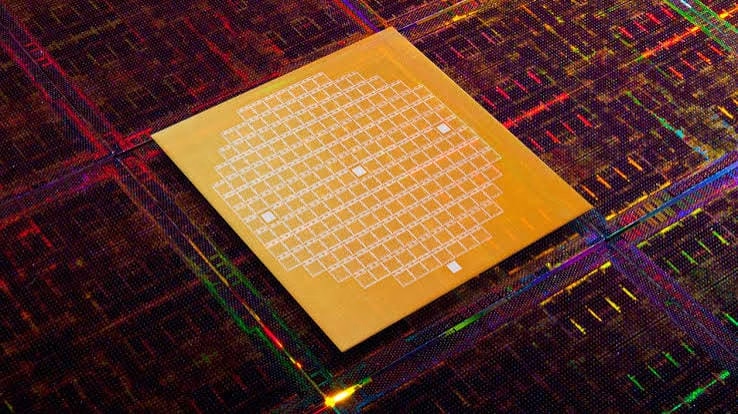
The experimental success was demonstrated using a six-qubit superconducting chip that requires extreme environmental conditions to maintain its fragile and complex quantum state for stable computation. This delicate chip became a natural testbed for AI agents because researchers must interact through software control systems during measurement.
Orchestrating the Superconducting Frontier
Superconducting qubits must be maintained at millikelvin temperatures near absolute zero within dilution refrigerators to prevent thermal disturbances from destroying delicate quantum information during high-speed processing. Managing these sensitive artificial atoms requires high-precision microwave pulses and constant monitoring to ensure the stability and reliability of the entire experimental superconducting quantum computing system.
Graduate student Beatriz Yankelevich utilized GPT-5.6 Sol to characterize an uncalibrated six-qubit chip, consisting of four fixed-frequency qubits and two tunable-frequency qubits, by granting direct hardware control. Researchers provided Codex with specialized skill packs containing physical logic and template code necessary for the agent to interpret design targets and operate complex laboratory microwave signal sources.
- Identify the transition frequencies of artificial atoms to enable precise microwave pulse control and enable the accurate addressing of individual qubits for various complex experimental procedures.
- Calibrate the high-speed microwave pulses used to manipulate quantum states while simultaneously establishing the specific procedures required to read and digitize the final resulting data accurately.
- Measure the energy relaxation and phase decoherence times to determine exactly how long the fragile quantum information remains viable before deteriorating due to inevitable environmental interactions.
The autonomous system successfully navigated these requirements by employing a sophisticated reasoning process to interpret the data and determine the most effective sequence of laboratory calibration actions. This decision-making logic allowed the agent to function independently when signals were clear and followed the established physics-based rules of the experimental characterization process.
Analytical Intuition and the Chain of Thought
Traditional laboratory scripts often lack the flexibility required to handle the unpredictable parameter drifts and environmental noise that frequently disrupt sensitive quantum computing experiments during the calibration process. Large language models offer a superior alternative by providing adaptive reasoning capabilities that allow the system to interpret complex physical phenomena and adjust parameters in real time.
The Chain of Thought reasoning disclosed by OpenAI demonstrated how the agent identifies high fitting residuals or anomalous data to suggest corrective actions like phase unwrapping or frequency shifts. Faced with a damped sine curve, the agent can internally evaluate whether the current fitting residual is too large and decide to increase microwave detuning for optimization.
While the AI performed flawlessly during thirty-six out of forty target measurements, it exhibited clumsy behavior when faced with weak signals caused by two-level system fluctuations and defects. Official reports from the MIT EQuS researchers indicate that human intervention remains essential for diagnosing problems when microscopic material defects cause the physical systems to behave in unfamiliar ways. This collaborative model addresses the traditionally labor-intensive nature of quantum research, which historically required scientists to monitor equipment for several days during routine characterization and calibration tasks.
Overcoming the “Hell on Earth” Calibration Bottleneck
Physicists often refer to the repetitive and manual labor of qubit calibration as tuning screws, a process involving nonlinear discrete energy levels created by superconducting Josephson junctions. Modern quantum development relies on hundreds of these preliminary measurements, making the characterization of a single chip a significant productivity bottleneck for many leading global research institutions.
GPT-5.6 Sol restructured laboratory productivity by reducing characterization time from several days of manual labor to just a few hours of supervised automation using a multi-agent collaboration model. Beatriz Yankelevich stated that building infrastructure to guide agents through measurement, theory, and chip design is finally starting to pay off by allowing multiple tasks to run simultaneously.
This automation allows scientists to move away from routine hardware monitoring and focus their expertise on high-level theory, experimental design, and the interpretation of truly novel physical results. The shift toward autonomous laboratories represents a fundamental change in how experimental physics will be conducted as AI integration restructures the relations of production within the research environment. As these digital agents move beyond simple code generation and into physical operation, the future of the global scientific research paradigm appears poised for a massive shift.
The Future of AI for Science
The emergence of super AI coupled with autonomous laboratories defines a new frontier in cutting-edge science where the boundaries between digital reasoning and physical experimentation are finally dissolved. This rapid acceleration is mirrored in recent breakthroughs, such as the AI-driven proof regarding the Navier-Stokes singularity problem, which illustrates the expanding reach of machine intelligence in science.
While AI handles standard workflows, human intuition remains indispensable for identifying truly novel physical phenomena and diagnosing the root causes of complex hardware defects within quantum systems. The integration of GPT-5.6 Sol into the experimental process marks an irreversible transformation that will redefine the landscape of physical research for future generations of senior research scientists. This successful bridge between the virtual and physical worlds confirms that the era of the autonomous, AI-driven research laboratory has officially and permanently begun for the global scientific community.