
Table of Contents
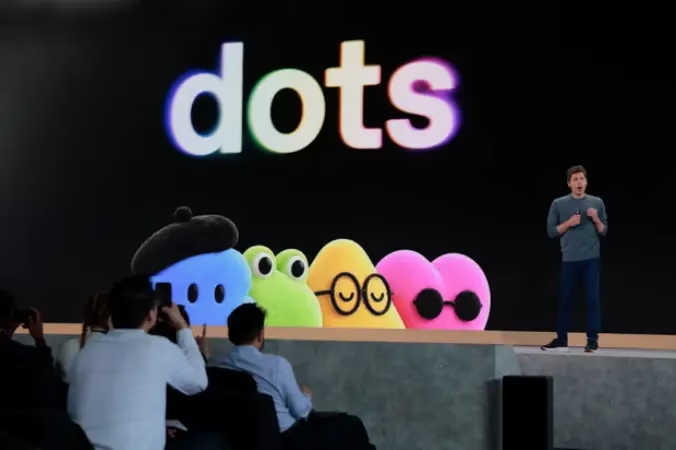
OpenAI has unveiled Dots, an “always-on” personal AI assistant designed to manage tasks autonomously, simplify workflows, and integrate fluently with thousands of digital tools.
The announcement denotes a major step in the evolution of AI-powered productivity solutions, positioning OpenAI as a key player within the rapidly growing market for autonomous agents.
What Is OpenAI Dots?
OpenAI Dots is a next-generation AI assistant powered by the company’s advanced GPT-6 Astra model.
Unlike conventional assistants that require manual input, Dots operates around the clock on users’ behalf, executing tasks, managing workflows, and even foreseeing needs.
Each Dot leverages its own cloud computer and web browser, enabling it to perform complex operations across more than 4,000 integrated apps.
Key Features and Capabilities
Dots features multiple groundbreaking features:
- 24/7 Autonomous Execution: Dots carries out tasks independently, sometimes completing work before the user even makes a request.
- Proactive Delegation: Users can treat their Dots as trusted digital delegates, bringing them into group chats and project teams from the very beginning.
- Dedicated Infrastructure: Each assistant runs on its own cloud-based computer and browser, supporting advanced multitasking.
- Deep App Integrations: Dots connects with major workplace applications like Slack, Microsoft Teams, and Google Drive for flawless workflow automation.
- Safety-First Design: Built-in protections, such as a “read-only” mode, prevent Dots from controlling devices without user permission.
Who Can Access Dots?
For now, Dots is available exclusively to subscribers of OpenAI’s Pro tier (ranging from $100 to $500 per month), Business Premium users, and select Enterprise customers.
Owing to regulatory requirements, Dots is not yet available in Europe or the United Kingdom.
OpenAI has hinted at plans to expand access and eventually introduce Dots to a larger audience as the technology matures.
How Dots Differs from Other Tools
Unlike classic project management or collaboration software, Dots operates as an autonomous agent rather than a passive platform.
While most apps require users to manually assign and track tasks, Dots takes initiative, runs entire workflows, and delivers results.
Its deep integration with thousands of applications, combined with its dedicated cloud infrastructure, sets it apart from standard productivity solutions.
Security, Privacy, and Compliance
OpenAI has emphasized user safety and privacy in Dots’ design. The platform includes strong safeguards like a “read-only” mode, which restricts the assistant’s control over devices when the user is not present.
While OpenAI has not revealed particular compliance credentials, it says Dots builds on the security measures established in its previous AI products.
Early Impact and Internal Use at OpenAI
Within OpenAI, Dots has already transformed work environment dynamics. Employees rely on their Dots as digital teammates, delegating both routine and complex tasks.
This change has allowed staff to reclaim focus, reduce device-checking, and devote more attention toward strategic projects, demonstrating the assistant’s capacity to reshape how teams work.
OpenAI’s Vision and What’s Next
OpenAI envisions Dots as the next stage of online collaboration, an environment in which AI agents act as proactive partners, not simply tools.
The company’s long-term goal is to make Dots widely available, authorizing users to pursue ambitious projects and freeing up human potential.
As Dots continues evolving, OpenAI strives to balance cutting-edge capability with safe deployment.
Conclusion
With Dots, OpenAI is establishing a new standard for AI-driven productivity, giving users unprecedented autonomy and support.
As competition for intelligent digital assistants intensifies, Dots stands out for its strong functions, deep integrations, and devotion to user safety, heralding an innovative era in how we work and collaborate.