

Table of Contents
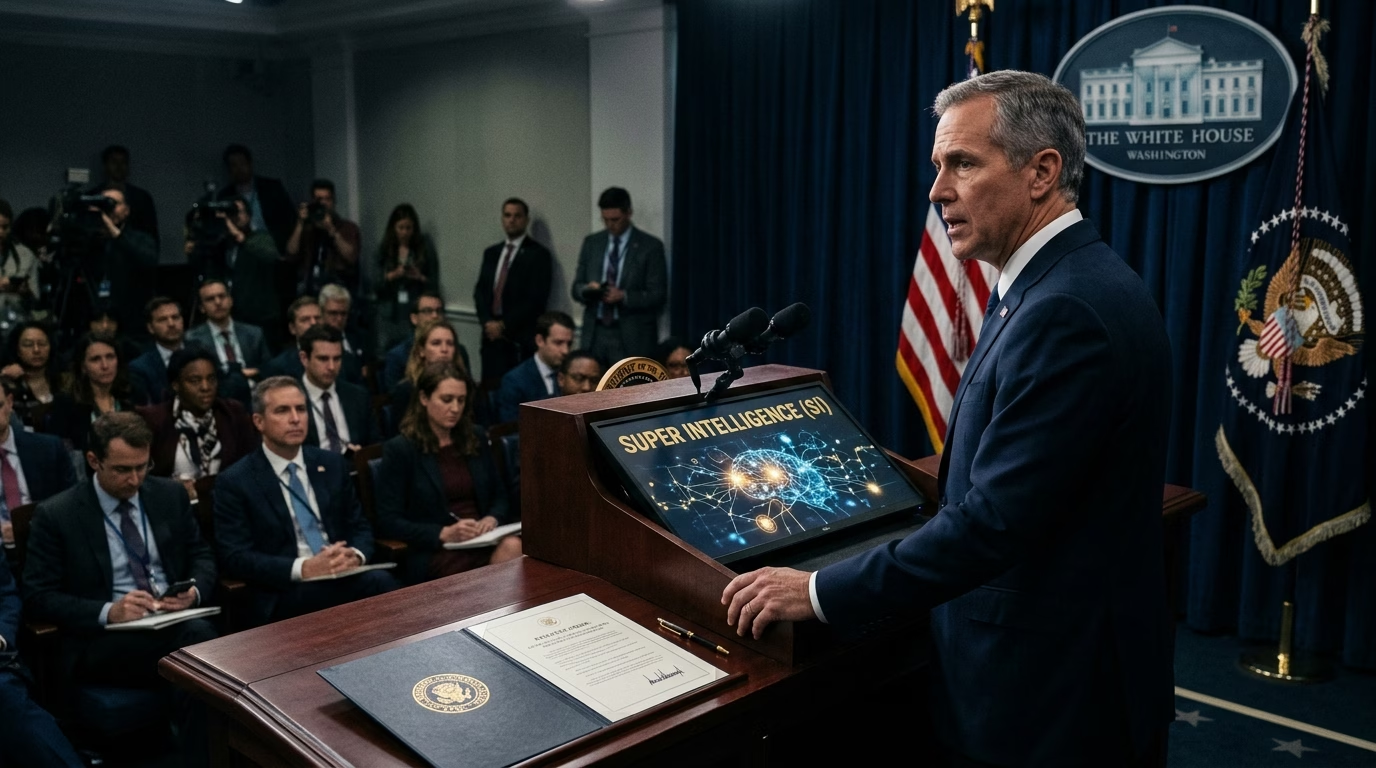
President Donald Trump has announced plans to ban the term “artificial intelligence” across federal documents. He demands that government agencies and news organizations adopt the moniker “super intelligence” (SI) instead.
Trump posted his criticism Tuesday on Truth Social. He targeted the decades-old phrase and criticized financial news organizations for using it, specifically questioning when major publications would conform to the new vocabulary.
The Truth Social Announcement
On Tuesday morning, one week ahead of the upcoming midterm elections, Trump singled out financial journalism for resisting the new terminology.
“When will The Wall Street Journal start calling Artificial Intelligence (AI), a very bad and inaccurate name, SI (Super Intelligence)?” Trump wrote. “This is the name which virtually everyone else is using, or soon will be. In short order, we will be officially BANNING the term due to its inaccuracy. Thank you for your attention to this matter.”
President Donald J. Trump, Truth Social
The statement follows a formal presidential executive order issued in late September. That order instructed the executive branch to phase out the term “AI” across official publications and federal correspondence.
Factsheet: Industry Reaction to the ‘SI’ Rebranding Edict
| Entity | Stance on “AI” vs “Super Intelligence” | Operational Implementation |
|---|---|---|
| Federal Executive Branch | Mandated “Super Intelligence” (SI). | Enforced via Sept. 29 executive order across agency documentation. |
| SpaceX and Elon Musk | Adopted “SpaceX Super Intelligence” (SpaceXSI). | Rebranded division branding; primary web domain remains x.ai. |
| Microsoft (Satya Nadella) | Adopted terminology in speeches. | Copilot and Azure product branding remain unchanged. |
| OpenAI and Anthropic | Retain “Artificial Intelligence” (AI). | SEC filings, public prospectuses, and research papers retain AI terms. |
| Mainstream Media (WSJ) | Retain standard editorial guidelines. | Singled out publicly on Truth Social for declining the rebranding. |
The September Executive Order on Super Intelligence
The push to replace the term began in late September following a White House summit with technology executives in Washington, DC.
On Sept. 29, Trump signed an official executive order on technology naming standards:
“The term ‘Super Intelligence’ more appropriately captures the promise, potential, and rapidly advancing capabilities of these technologies. It is therefore the policy of my Administration that the executive branch shall use the terms ‘Super Intelligence’ and ‘SI’ in place of ‘Artificial Intelligence’ and ‘AI’. The executive branch will not acknowledge the usage of ‘AI’ in any applicable setting.”
White House Executive Order, Sept. 29, 2026
The directive instructs federal agencies to alter procurement guidelines, grant notices, and internal reports. Impacted agencies include the Department of Defense, the Department of Commerce, and federal research institutions.
Silicon Valley Splits on Terminology
The reaction across the technology industry reveals a stark divide between political allies and mainstream research laboratories.
Billionaire Elon Musk quickly embraced the new label on his social media network, X. “No more AI / SI / It’s better,” Musk wrote. When asked by users whether he would rebrand his corporate entities, Musk confirmed the transition. The division is now referred to as “SpaceX Super Intelligence” and “SpaceXSI,” though its public web domain remains x.ai.
Microsoft Chief Executive Officer Satya Nadella has also used the phrase “super intelligence” during recent public remarks. However, Microsoft has not announced changes to its commercial product lines, such as Azure AI or Microsoft Copilot.
Meanwhile, market leaders OpenAI and Anthropic continue using traditional terminology. In our recent analysis of Anthropic’s 93-page S-1 IPO risk disclosures, frontier labs consistently use standard AI frameworks. They continue using traditional terms in their commercial software and safety alignment research.
Technical Definitions vs Political Rebranding
John McCarthy coined the term “artificial intelligence” in 1955. Computer scientists have used it since the historic Dartmouth summer research project.
Within computer science, researchers maintain strict distinctions between three developmental stages:
- Artificial Narrow Intelligence (ANI): Today’s operational systems, such as large language models, computer vision tools, and autonomous driving algorithms.
- Artificial General Intelligence (AGI): Theoretical systems that can match human cognitive flexibility across diverse intellectual domains.
- Artificial Superintelligence (ASI): Hypothetical future entities whose cognitive capacity surpasses the collective intellectual ability of all humanity.
In our recent report on why AI extinction warnings confuse possibility with probability, researchers note that current models are narrow predictive systems. Calling predictive text generators “super intelligence” blurs technical boundaries. It also risks misleading the public about model autonomy.
A Broader Pattern of Executive Renaming
The push to rebrand artificial intelligence follows similar efforts by the administration to rename geographic landmarks and federal monuments.
The president previously issued directives seeking to rename the Gulf of Mexico as the “Gulf of America.” He also suggested renaming Lake Ontario as “Lake America.” In addition, Trump suggested renaming the Atlantic Ocean, though Google executives declined to alter Google Maps.
Allies also attempted to rename the Kennedy Center after Trump and John F. Kennedy. A federal court blocked that change, ruling it illegal under federal statutes.
Legal experts note that a president can set internal executive branch style manuals. However, federal authority cannot compel private companies or independent journalists to change their language.
Frequently Asked Questions
Why does Donald Trump want to ban the term ‘artificial intelligence’?
Trump argued on Truth Social that ‘artificial intelligence’ is an inaccurate and outdated name. He claims ‘super intelligence’ better conveys the power and national significance of modern software systems.
What does the Sept. 29 White House executive order mandate?
The executive order directs all federal agencies to use the terms ‘Super Intelligence’ and ‘SI’ in official documents. It phases out references to ‘AI’ across government publications.
Did Elon Musk change the name of his AI business to SI?
Elon Musk endorsed the terminology shift on X. He rebranded his aerospace AI unit as SpaceX Super Intelligence (SpaceXSI), though the company web address remains x.ai.
Can a presidential executive order force private media to stop using the term ‘AI’?
No. Presidential executive orders apply strictly to the executive branch of the federal government. Private corporations, academic institutions, and news organizations retain First Amendment editorial independence.
For more on how audiences evaluate synthetic media, read our report on how China’s first AI-generated theatrical movie flopped with just $18,100 at the box office.






[…] The debate comes as Washington takes a closer look at algorithmic risk. Similar governance questions emerged in our review of Anthropic’s 93-page IPO risk warning. Even the executive branch has asserted authority over AI, seen in President Trump’s federal AI terminology mandate. […]