
Stanford theoretical physicist Venkatesa Chandrasekaran sparked intense debate across physics and technology circles in November 2026 after posting an 83-page arXiv preprint built with OpenAI’s GPT-6 Astra model, according to Business Insider.
Chandrasekaran, who is also a member of OpenAI’s reasoning research group, wrote that developing the paper’s algebraic derivations consumed roughly 400 million tokens over several months.
Executive Summary
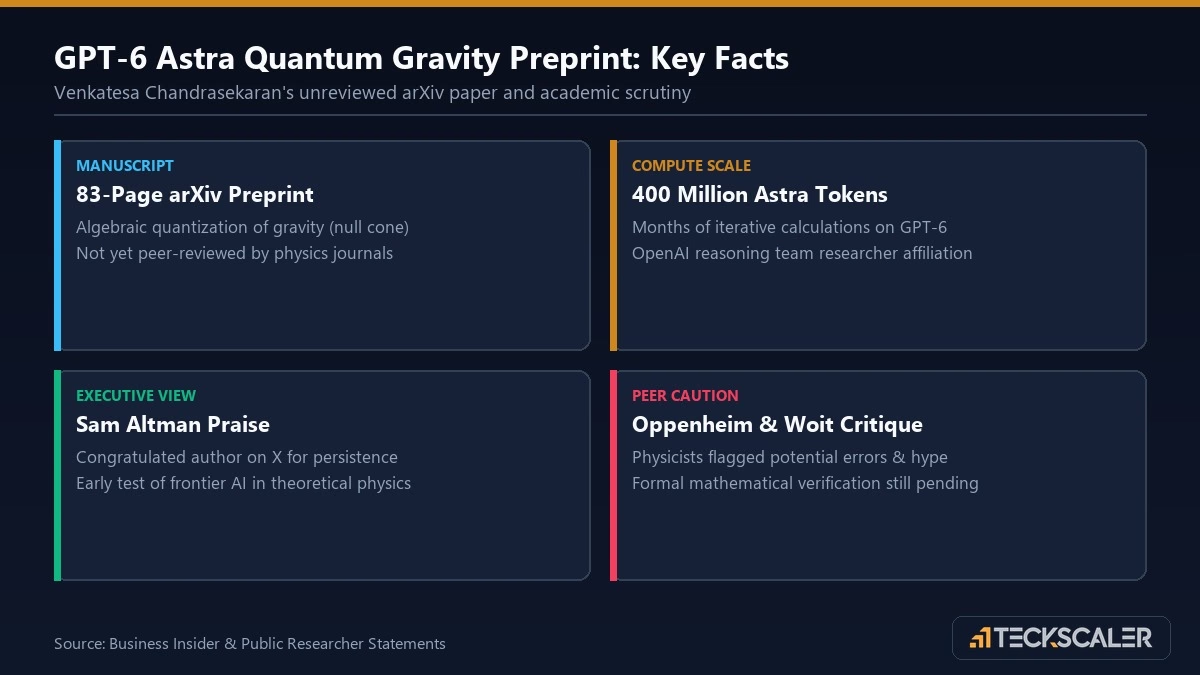
- 83-Page Preprint: Stanford theoretical physicist Venkatesa Chandrasekaran, who also works on OpenAI’s reasoning team, posted an unreviewed 83-page paper on arXiv.
- Massive Token Budget: The paper acknowledges consuming roughly 400 million tokens of compute on OpenAI’s GPT-6 Astra model over months of mathematical derivations.
- Altman Endorsement: OpenAI CEO Sam Altman praised Chandrasekaran on X as an early believer in applying frontier reasoning models to fundamental physics.
- Peer Review Caution: Physicists and mathematicians including Jonathan Oppenheim and Peter Woit questioned unreviewed claims and warned against premature hype.
Overview of the November 2026 GPT-6 Astra Quantum Gravity Preprint
| Research Attribute | Reported Detail | Verification & Peer Review Status |
|---|---|---|
| Lead Author | Venkatesa Chandrasekaran (Stanford & OpenAI researcher) | Dual academic and corporate lab affiliation disclosed. |
| Paper Title | An algebraic quantization of gravity from the null cone | 83-page arXiv preprint (not yet peer-reviewed). |
| AI Compute Used | ~400 million tokens via OpenAI GPT-6 Astra | Used over months for iterative algebraic calculations. |
| Scientific Reception | Mixed reactions from Jonathan Oppenheim & Peter Woit | Independent validation and journal review still pending. |
Attempting quantum gravity reconciliation under limited conditions
Titled ‘An algebraic quantization of gravity from the null cone,’ the unreviewed manuscript explores a mathematical approach linking general relativity and quantum mechanics under restricted vacuum settings.
In the acknowledgments, Chandrasekaran credited back-and-forth sessions with GPT-6 Astra for working through complex calculations and proof structures.
OpenAI CEO Sam Altman congratulated Chandrasekaran on X, calling him one of the earliest researchers committed to using AI on hard scientific problems.
Physicists urge caution pending peer review
Independent researchers quickly urged restraint until formal peer review evaluates every proof step inside the 83-page manuscript.
Physicist Jonathan Oppenheim and mathematician Peter Woit raised sharp skepticism over the work, pointing to potential mathematical issues and cautioning against promotional exaggeration.
The split reaction mirrors earlier 2026 debates over AI-generated mathematics proofs, where formal theorem checkers are often needed before claims enter textbooks.
Frequently Asked Questions
Who wrote the OpenAI Astra quantum gravity paper?
Stanford University physicist Venkatesa Chandrasekaran, who also works on OpenAI’s reasoning team, authored the 83-page arXiv preprint.
How much AI compute did the quantum gravity study consume?
The preprint acknowledged consuming approximately 400 million tokens across months of iterative mathematical derivations on OpenAI’s GPT-6 Astra model.
Has the paper passed scientific peer review?
No. The manuscript is an unreviewed preprint on arXiv, and independent physicists including Jonathan Oppenheim and Peter Woit have expressed skepticism pending formal verification.
Related Analysis & Guides
- Did OpenAI Reach AGI? Inside the GPT-6 Astra Debate
- Anthropic Researcher Tests Riemann Proof With Lean Kernel
Primary Sources & References
Published by the TeckScaler Editorial Team.
Additional physicist reviews and automated checks
University College London physicist Jonathan Oppenheim reported dispatching a swarm of Anthropic Claude agents to inspect the preprint, noting the agents flagged more than a dozen issues. Chicago State University astrophysicist Hontas Farmer added on X that the draft proposes nothing testable and overlaps with existing literature, while theoretical physicist Nirmalya Kajuri wrote that pre-AI papers with similar scope drew little attention.