
Beliefs about severe artificial intelligence risks are driving sharply conflicting personal finance choices among leading researchers, according to interviews with six AI safety experts published by Business Insider in late November 2026.
While some researchers halted retirement contributions over near-term loss-of-control fears, others continue maxing out retirement accounts or hedging future wage loss with semiconductor and neocloud stocks.
Executive Summary
- Abandoning 401(k) Plans: MIRI president Nate Soares has not contributed to his 401(k) for a decade and Evitable leader David Krueger stopped retirement planning altogether, both estimating over 50 percent extinction risk.
- Hedging Through Chips: FAR.AI CEO Adam Gleave pegs catastrophe risk at 15 percent over decades and saves more aggressively, tilting roughly half his portfolio into CoreWeave, Nebius, Micron, SK Hynix, and chip ETFs.
- Staying Conservative: University of Louisville professor Roman Yampolskiy puts extinction risk at 99.9 percent over a century yet still maximizes retirement savings to avoid poverty in surviving scenarios.
- Balanced Advice: Balsa Research founder Zvi Mowshowitz (~70 percent lifetime risk) and former DeepMind researcher Andreas Kirsch maintain standard retirement savings alongside diversified holdings.
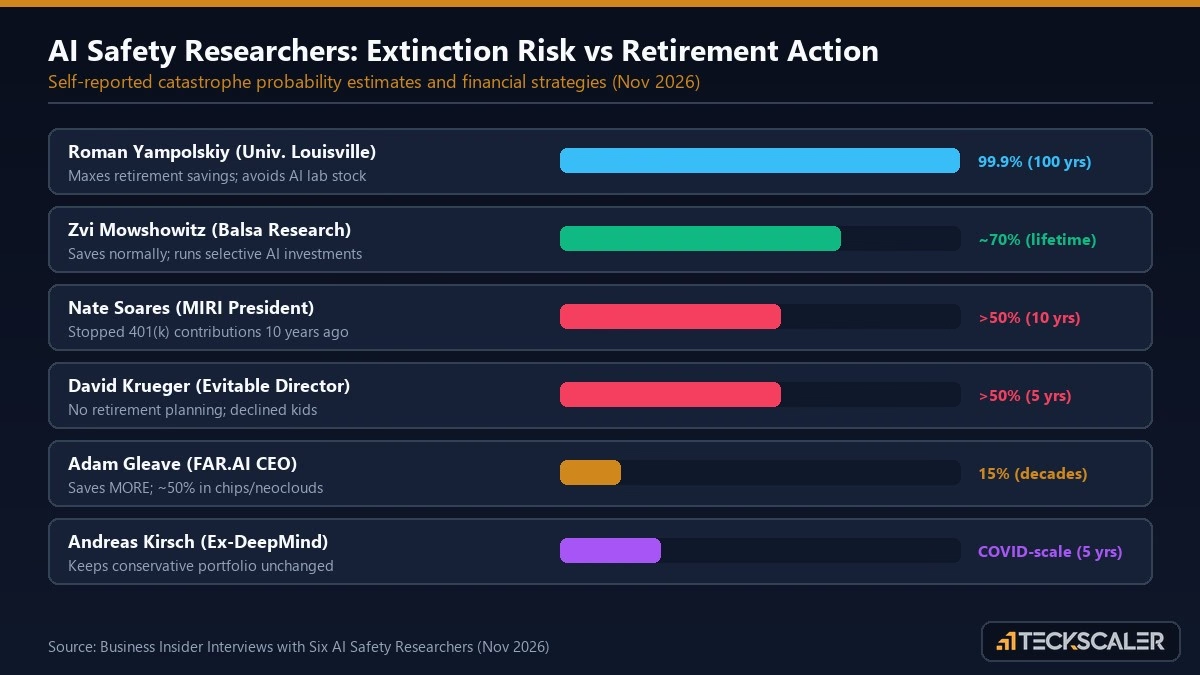
AI Safety Researchers: Risk Estimates and Financial Plans
| Researcher & Role | Estimated Risk Timeline | Personal Saving & Investing Approach |
|---|---|---|
| Roman Yampolskiy (Univ. of Louisville) | 99.9% extinction over next century | Maximizes retirement contributions; avoids AI lab equity. |
| Zvi Mowshowitz (Balsa Research) | ~70% catastrophe in natural lifetime | Maintains normal retirement savings plus AI-thesis bets. |
| Nate Soares (MIRI President) | >50% extinction within 10 years | Stopped 401(k) contributions 10 years ago. |
| David Krueger (Evitable Director) | >50% extinction within 5 years | Declined children and avoids retirement planning. |
| Adam Gleave (FAR.AI CEO) | 15% over decades (5% near-term) | Saves more; ~50% in neoclouds, memory makers, and chip ETFs. |
| Andreas Kirsch (Ex-DeepMind) | COVID-scale crisis quite likely in 5 yrs | Keeps conservative financial plans unchanged. |
Researchers halting retirement contributions
Machine Intelligence Research Institute president Nate Soares said he stopped adding money to his Google-era 401(k) a decade ago and estimates a greater than 50 percent probability of human extinction within 10 years.
Evitable executive director David Krueger put extinction odds above 50 percent inside five years, noting he gave up higher-paying industry roles, chose not to have children, and spends no time planning for retirement.
Both researchers emphasize they are working to reduce existential risks rather than treating human extinction as unavoidable.
Why high-risk estimates still motivate retirement saving
University of Louisville computer science professor Roman Yampolskiy estimates a 99.9 percent probability of extinction over the next century, yet still maximizes retirement savings to guard against living poor in the remaining 0.1 percent survival scenario.
Zvi Mowshowitz of Balsa Research estimates roughly a 70 percent lifetime catastrophe risk, yet keeps standard retirement plans intact for family security while making selective AI investments.
Former Google DeepMind researcher Andreas Kirsch sees a pandemic-scale crisis as plausible within five years without strict oversight, but advises keeping conservative investment plans unchanged.
Semiconductor and neocloud hedges
FAR.AI chief executive Adam Gleave assigns a 15 percent long-term catastrophe probability and increases his savings rate to prepare for potential white-collar wage disruption.
Portfolio disclosures shared with Business Insider showed half of Gleave’s holdings in global equity indexes and half across CoreWeave, Nebius, Micron, SK Hynix, and the VanEck Semiconductor ETF.
Frequently Asked Questions
Do all AI safety researchers stop saving for retirement?
No. Out of six researchers interviewed by Business Insider, four continue saving or investing for retirement while two stopped active retirement planning.
Which stocks did FAR.AI CEO Adam Gleave hold as an AI hedge?
Gleave held positions in neocloud providers CoreWeave and Nebius alongside memory chip makers Micron, SK Hynix, and the VanEck Semiconductor ETF.
Why does Roman Yampolskiy still save despite a 99.9% risk estimate?
Yampolskiy noted that a 0.1 percent survival chance still justifies financial preparation so he will not end up poor if humanity navigates past AI risks.
Related Analysis & Guides
- Hunger strike targets self-improving AI at Anthropic SF HQ
- Anthropic CEO Amodei Denies Wanting Humans to Surrender Control
Primary Sources & References
Published by the TeckScaler Editorial Team.