


Autonomous shopping agents from OpenAI, Meta, Google, and Instinct are encountering widespread blocks from major retailers and banks ahead of the 2026 holiday rush, according to CNBC reporting published on November 27.
While Walmart and Sephora welcome AI buyers to browse deals, Amazon, eBay, United Airlines, Kohl’s, and JPMorgan Chase restrict or outright reject automated agent traffic over fraud, liability, and bot verification fears.
Executive Summary
- Major Store Blocks: Amazon, eBay, United Airlines, and Kohl’s limit automated agent actions or block bots completely, while JPMorgan Chase barred external shopping agents citing security.
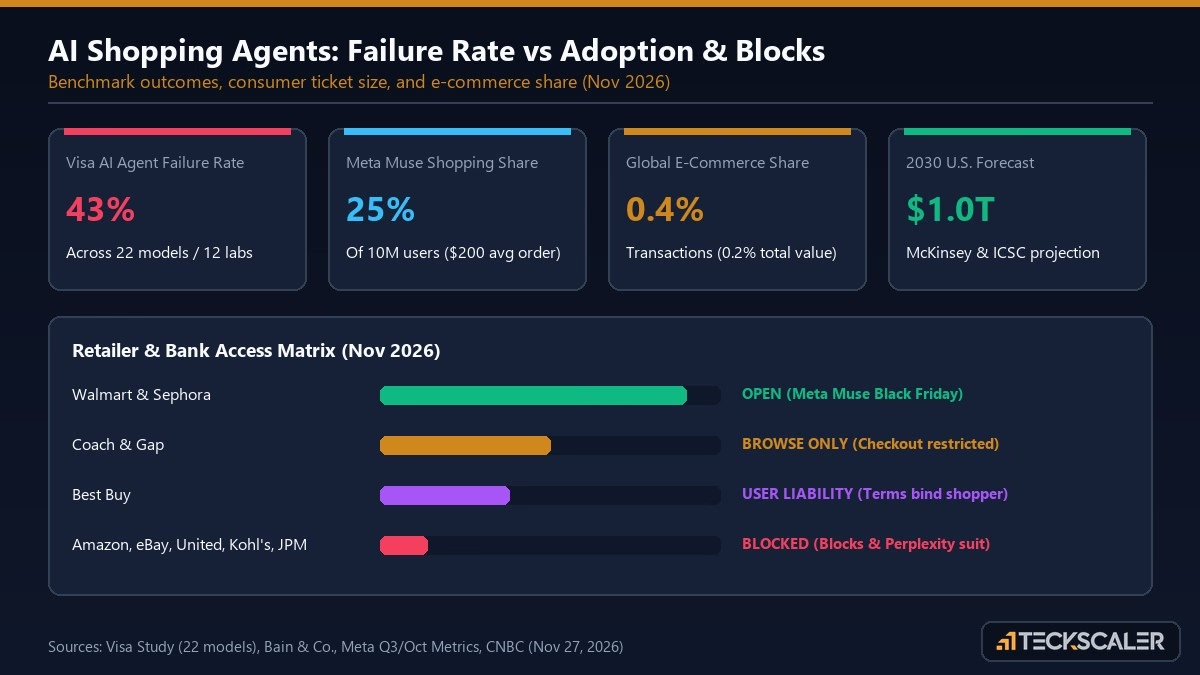
- High Error Rates: A Visa study testing 22 AI models from 12 labs recorded a 43 percent shopping failure rate, with over half of failures buying products outside user instructions.
- Small Share Today: Bain & Co. found agentic transactions make up 0.4 percent of global e-commerce volume and 0.2 percent of spend value, though McKinsey and ICSC project up to $1 trillion in U.S. revenue by 2030.
- Liability Split: American Express and Stripe Link offer refund coverage for eligible agent errors, whereas Best Buy terms hold shoppers legally responsible for bot orders.
Merchant and Financial Rules for AI Shopping Agents
| Company | Agent Posture | Key Policy or Volume Metric |
|---|---|---|
| Amazon | Blocked | Blocked Meta Muse in Sept, stopped Grok Bot, and sued Perplexity over Comet. |
| Walmart & Sephora | Open / Partnered | Walmart promoted Meta Muse Black Friday deals across retail inventory. |
| Coach & Gap | Browse Only | Permit bots to inspect pages but restrict automated checkout completion. |
| JPMorgan Chase | Blocked | Barred third-party customer agents last month citing security risk. |
| Best Buy | User Liability | Treats Digital Agent orders in terms of service as shopper actions. |
Reliability gaps and failed checkout tests
Even on open websites, shopping bots struggle with login prompts, CAPTCHAs, and accurate product selection.
A November Visa study covering 22 models from 12 AI labs recorded a 43 percent task failure rate, and more than half of those failed runs purchased items missing buyer specifications.
Real buyers ran into similar errors, including fintech executive Maia Bittner receiving an AutoZone cancellation from Meta’s Muse after 17 hours and an unvetted discount listing from an unknown storefront.
Amazon lawsuits and identity verification fixes
Amazon took the sharpest defensive stance by blocking Meta’s Muse in September, blocking xAI’s Grok Bot in October, and suing Perplexity in November over claims its Comet agent masked automated traffic.
Amazon CEO Andy Jassy said third-party partnerships will depend on negotiating the right value exchange, while Forrester analyst Emily Pfeiffer warned that blocks prevent AI shoppers from seeing full market options.
Payments startup Skyfire CEO Amir Sarhangi noted agents often mask IP origins via data centers and pay with single-use virtual cards, prompting demand for protocols proving human consent.
Tiny current share vs $1 trillion forecast
Bain & Co. data indicates agentic purchases currently account for just 0.4 percent of global e-commerce transactions and 0.2 percent of spend value, alongside 504 weekly agent orders disclosed by Uber during October.
Still, roughly a quarter of Meta Muse’s 10 million users shop with agents averaging $200 per order, while Instinct CEO Noah Shinn reported average purchases above $500 and McKinsey forecasts up to $1 trillion in U.S. agentic commerce by 2030.
Frequently Asked Questions
Why is Amazon blocking AI shopping agents like Meta Muse and Grok?
Amazon blocked Meta’s Muse and xAI’s Grok Bot and sued Perplexity over Comet because it did not approve third-party checkout automation and wants clear value exchange agreements.
How often did AI shopping agents fail in Visa’s 2026 benchmark?
Visa tested 22 models across 12 AI labs and found agents failed roughly 43 percent of shopping runs, with more than half of failures buying wrong items.
Who pays if an AI agent makes an accidental purchase?
American Express and Stripe’s Link wallet protect eligible agent errors, while Best Buy’s terms place full responsibility on the account holder.
Related Analysis & Guides
- Meta Launches Live Video Chat and Muse AI Avatars
- OpenAI merges ChatGPT and Codex into shared usage token pool
Primary Sources & References
Published by the TeckScaler Editorial Team.

[…] AI shopping agents from OpenAI and Meta hit retailer blocks […]