

A new wave of open-source AI decision models is gaining developer traction following TypeSafe AI’s release of Jev, according to a technical roundup published by KDnuggets.
Instead of prompting a large language model to generate verbose paragraphs and parsing out JSON, decision models take a question plus fixed options and immediately return ranked probabilities.
Executive Summary
- Structured Output Shift: Following TypeSafe AI’s release of Jev, developers are adopting dedicated decision models that return ranked choice probabilities instead of long text paragraphs.
- Cost & Latency Cuts: Lightweight decision models handle model routing, approval checks, and tool selection faster and on smaller GPUs than general-purpose LLMs.
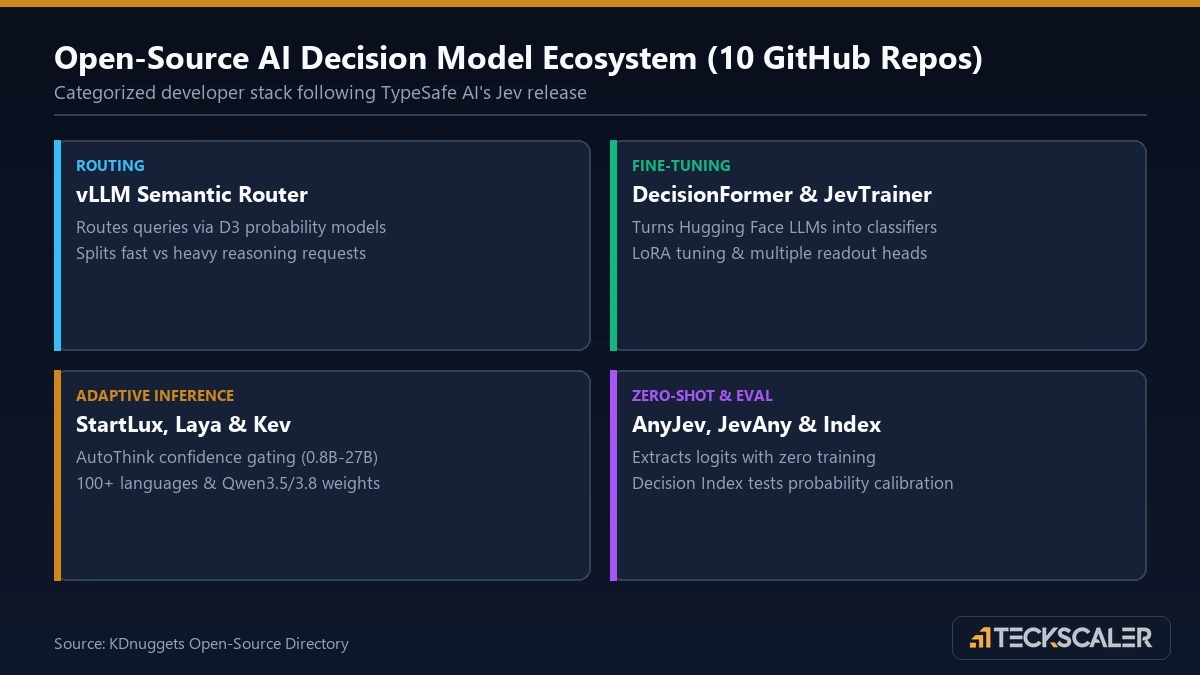
- Ten Curated Projects: KDnuggets profiled 10 GitHub projects covering routing (vLLM Semantic Router), fine-tuning (JevTrainer, DecisionFormer), and inference (Laya, Kev).
- Zero-Shot & Calibration: Tools like AnyJev extract internal token probabilities without training, while Decision Index benchmarks calibration accuracy.
10 Open-Source GitHub Repositories for AI Decision Models
| Repository Name | Primary Function | Key Technical Capability | Suggested Developer Project |
|---|---|---|---|
| vLLM Semantic Router | Request & model routing | Supports D3 decision models for probability-based routing | Route queries between small fast models and reasoning models. |
| DecisionFormer | Hugging Face conversion | Fine-tunes existing LLMs into decision classifiers | Fine-tune Qwen into Approve/Reject/Review support classifier. |
| StartLux-Decision | Adaptive 0.8B to 27B models | AutoThink switches reasoning on only when uncertain | Trigger deep thinking only below confidence thresholds. |
| JevTrainer | Model training framework | LoRA/full tuning with interchangeable decision readout heads | Benchmark 3 readout heads on calibration and speed. |
| Laya | Non-autoregressive engine | Multiple-choice and scoring across 100+ languages | Build multilingual Allow/Review/Block content moderation. |
| Kev | Open Qwen3.5/3.8 models | Pretrained weights, uv setup scripts, and serving examples | Train an agent tool-selection router on custom logs. |
| JevAny | Multimodal end-to-end suite | Trains and serves text or image decision APIs | Deploy a support-ticket triage API from a small Qwen base. |
| AnyJev | Training-free conversion | Reads internal token probabilities from open LLMs directly | Turn Qwen into a Buy/Hold/Sell scorer with zero fine-tuning. |
| Decision Index | Benchmarking & calibration | Reproducible local or Hugging Face Jobs eval suites | Compare accuracy vs. confidence calibration on D3 and Kev. |
| Awesome Decision Models | Curated ecosystem index | Directory of research papers, SDKs, and open weights | Compare speed and memory across 3 candidate models. |
Routing and adaptive inference tools on GitHub
For production traffic routing, vLLM Semantic Router pairs with D3 decision models to pick fast or heavy models in milliseconds without generating text.
StartLux-Decision releases 0.8B to 27B parameter models using an AutoThink loop that outputs direct answers when confident and activates extra reasoning steps only when uncertainty rises.
Meanwhile, Laya offers non-autoregressive inference across more than 100 languages for fast content moderation and scoring.
Training suites, zero-shot wrappers, and Qwen weights
Engineers building custom classifiers can use DecisionFormer or JevTrainer to fine-tune Hugging Face models with LoRA and compare different readout heads.
Kev ships pretrained decision models built atop Qwen3.5 and Qwen3.8 with uv workflows, while JevAny extends end-to-end training to multimodal image and text tickets.
Developers wanting zero training overhead can run AnyJev, which pulls internal token logits from existing open weights to rank multiple-choice answers directly.
Evaluating confidence calibration and curated resources
Because a model reporting 90 percent confidence is not always right 90 percent of the time, Decision Index offers reproducible calibration benchmarks for local runs or Hugging Face Jobs.
Developers exploring the ecosystem can also browse Awesome Decision Models, a community index tracking papers, SDKs, and open model releases.
Frequently Asked Questions
What is an AI decision model?
An AI decision model takes a prompt, context, and predefined candidate options, then outputs structured choice probabilities directly instead of generating long conversational text.
Which tool converts open LLMs into decision models without fine-tuning?
AnyJev converts open language models into decision scorers without training by reading internal token probabilities across predefined candidate choices.
How do developers test whether decision model confidence scores are accurate?
Decision Index provides reproducible benchmark suites that measure accuracy, latency, and confidence calibration across models like D3 and Kev.
Related Analysis & Guides
- Google Gemini API Adds Tool Retrieval to Cut Token Costs
- Enterprise Prompt Engineering: Scaffolding & Schemas Guide
Primary Sources & References
Published by the TeckScaler Editorial Team.