


Executive Summary
- Next Frontier Model. Google launched Gemini 4 Carbon. It is Google’s top model for cyber defense and long-horizon engineering tasks.
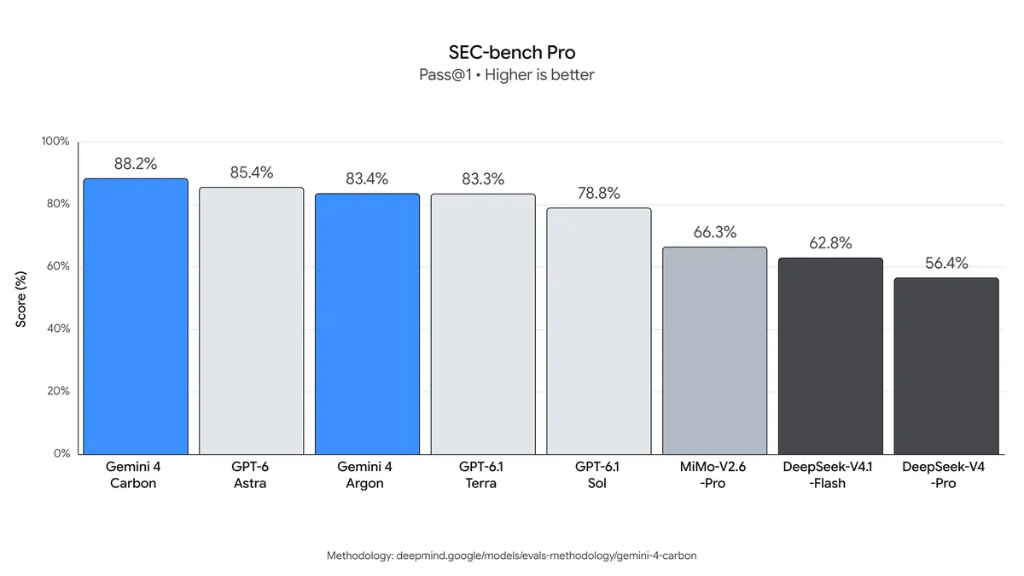
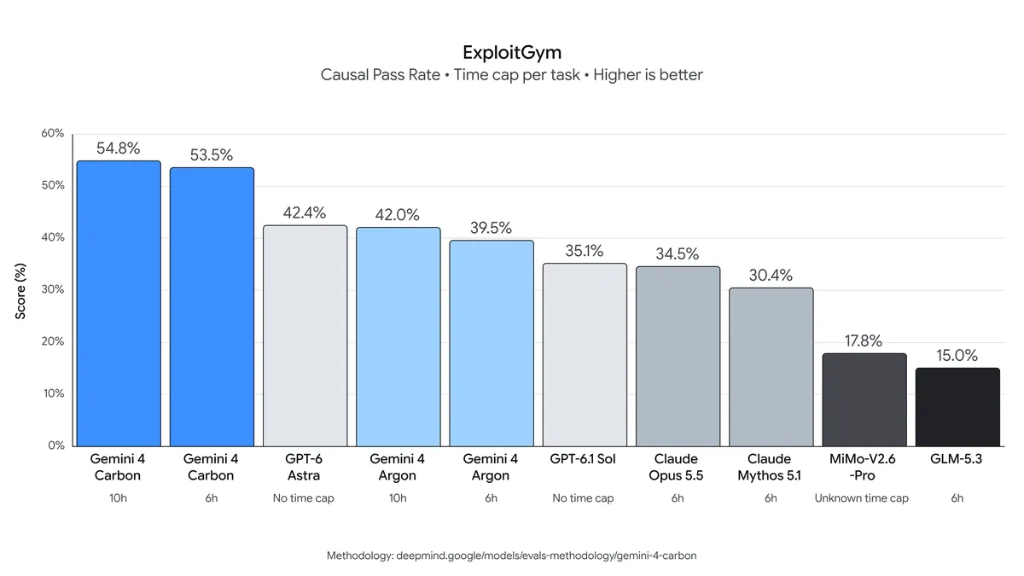
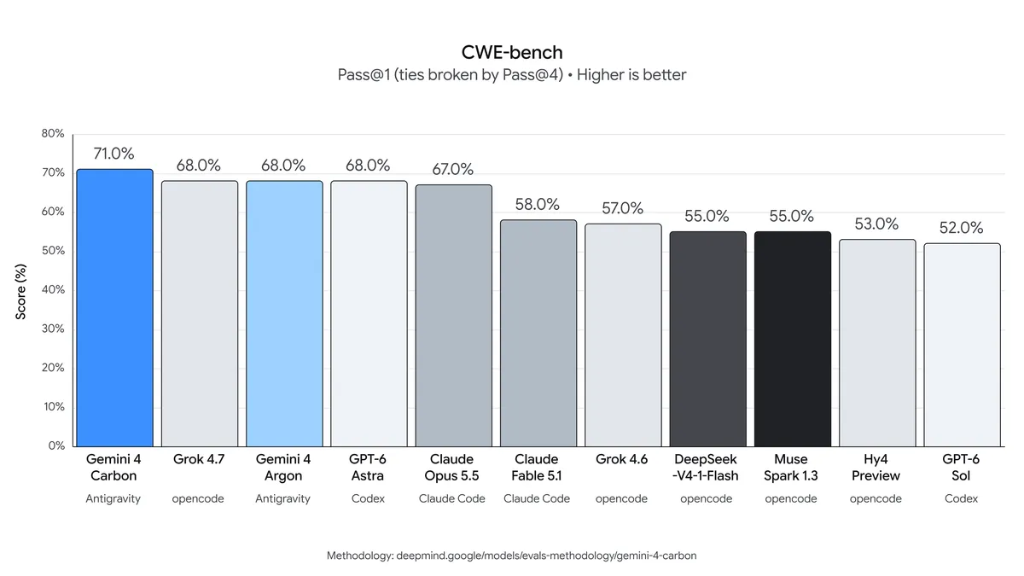
- Full-Spectrum Defense Lead. Carbon leads across the defense cycle: 88.2% on SEC-bench Pro (detection), 54.8% on ExploitGym (validation), and 71.0% on CWE-bench (patching).
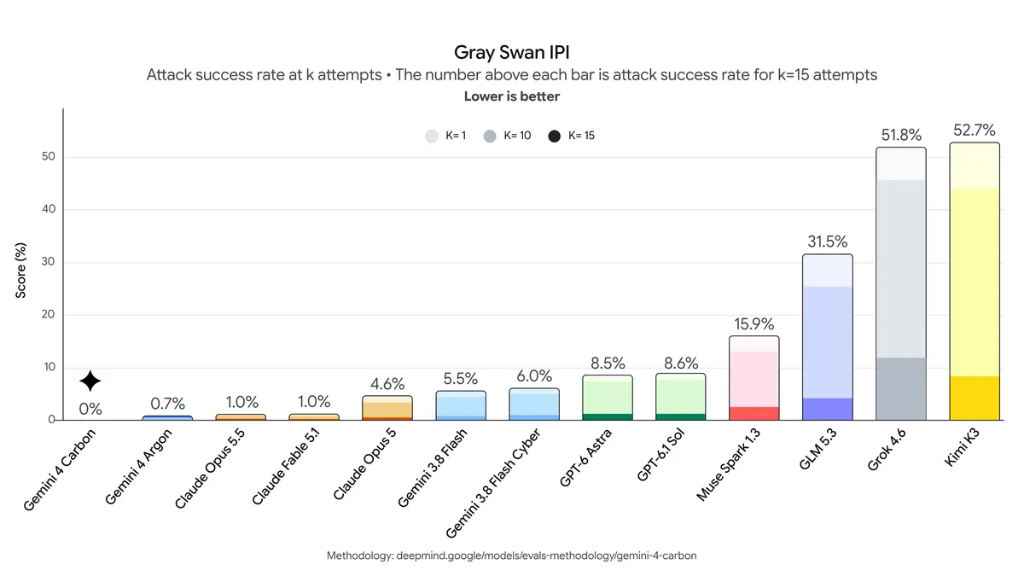
- Zero Prompt Injection Risk. On the Gray Swan Indirect Prompt Injection test, Carbon achieved a 0.0% attack success rate, stopping every attack attempt.
- Sustained Autonomous Coding. Carbon can run multi-step tasks for days without stalling. It gained 89 Elo points to reach fourth place on WebDev Arena.
- Deliberate Phased Rollout. Access starts under U.S. government testing via the Fairwind Program. Tokens cost $2 per million input and $10 per million output.
Google has launched Gemini 4 Carbon. The release stands as Google’s strongest model yet for digital defense and complex coding jobs.
The launch comes two weeks after Gemini 4 Argon. It highlights how fast Google DeepMind is moving. Carbon immediately claimed the top spot on version 5.0 of the Artificial Analysis Intelligence Index with a score of 59. The model delivers major gains across coding tasks, software auditing, and multi-step reasoning.
Table of Contents
Full-Spectrum Cyber Defense: Detection, Validation, and Patching
Digital defense requires three clear steps. Security teams must find code flaws. They must test if hackers can use them. Then they must patch the root cause. Past models often struggled to finish all three steps without human help. Gemini 4 Carbon sweeps all three stages with record test scores.
1. Finding Real Flaws: On SEC-bench Pro, Carbon achieved an 88.2% pass rate. It reliably uncovers complex security flaws in real-world software systems.
2. Testing Exploit Risk: Cyber teams need to know which bugs pose immediate danger. On ExploitGym, Carbon set a new high mark of 54.8%. It helps defenders confirm which flaws can be exploited before attackers find them.
3. Patching Root Causes: Fixing the root cause is the key final step. On Collinear’s CWE-bench, Carbon reached 71.0%. It converts verified findings directly into working code fixes.
Early field testing shows real practical gains. Google’s Chrome security team tested Carbon in real workloads. The model built quality patches ten times better than rival frontier models. Cloud security firm Wiz also praised Carbon. The model led penetration testing for the firm’s Scan for Good work.
Comparison Factsheet: Frontier Model Cyber Benchmarks
The factsheet below compares Gemini 4 Carbon with leading frontier models across core security, alignment, and coding metrics.
| Evaluation Metric | Gemini 4 Carbon | Gemini 4 Argon | GPT-6 Astra | Claude Opus 5.5 |
|---|---|---|---|---|
| Artificial Analysis Index (v5.0) | 59 (Rank 1) | 56 | 57 | 56 |
| SEC-bench Pro (Detection) | 88.2% | 83.4% | 85.4% | Not Reported |
| ExploitGym (Validation) | 54.8% | 42.0% | 42.4% | 34.5% |
| CWE-bench (Patching) | 71.0% | 68.0% | 68.0% | 67.0% |
| Gray Swan IPI (Attack Risk) | 0.0% (Zero Risk) | 0.7% | 8.5% | 1.0% |
| WebDev Arena (Elo Score) | 1768 (Rank 4) | 1679 | 1740 | 1752 |
| Input Token Pricing | $2.00 / M | $2.00 / M | $3.00 / M | $3.00 / M |
| Output Token Pricing | $10.00 / M | $10.00 / M | $15.00 / M | $15.00 / M |
Zero Prompt Injection and Stronger Model Alignment
Frontier models face threats from hidden attacks. In prompt injection attacks, bad actors hide hostile prompts inside web pages or code files. This threat has become a major focus of enterprise security teams monitoring AI cyber attacks and automated malware.
On the Gray Swan Indirect Prompt Injection test, Carbon achieved a 0.0% attack success rate. It resisted every evaluated attack attempt. In contrast, Argon recorded 0.7%, Claude Opus 5.5 scored 1.0%, GPT-6 Astra scored 8.5%, and Grok 4.6 recorded 51.8%.
Google also improved model alignment and honest responses:
No Code Shortcuts: On Terminal-Bench 4.0, cheating fell to 0.0%. Attempts to find shortcuts dropped to 0.4%. High-severity misalignment alerts dropped by nearly 80% during internal live coding.
Honest Boundaries: Carbon cut unsupported claims in half compared to Argon. The model places clear caveats directly in its output. When data is missing, it pauses rather than guessing.
Disciplined Plan Execution: Carbon cut plan overreach by 26% and reduced under-service by 29%. This keeps autonomous agents strictly within project rules and scope.
Long-Horizon Agent Coding and WebDev Arena Gains
Carbon is engineered for sustained agent workflows. DeepMind teams observed Carbon running multi-step jobs for days. It pushed through dead ends and patched subtle bugs in large codebases without stalling.
This reliability mirrors growing enterprise demand for sustained coding tools, as seen in Anthropic’s 900% net revenue retention for Claude Code. In full-stack web development, Carbon jumped 89 Elo points. It landed at fourth place on WebDev Arena with a score of 1768.
Rollout Strategy, Fairwind Program, and Pricing
Google is rolling out Carbon under the voluntary testing plan run with the U.S. government. Access starts this week for trusted cyber defenders. Google will expand access through its Fairwind Program before broader public release.
Pricing matches the introductory rates of Argon. Google charges $2 per million input tokens and $10 per million output tokens. Cached input tokens receive a 95% discount off the base input price.
Explore Engineering Utilities and AI Solutions
Test payload formats, token calculations, and text transformations using our suite of Free Online Developer Tools.
Deploying frontier AI models or hardening enterprise agent workflows against prompt injection? Consult with TeckScaler’s enterprise IT specialists →
As frontier labs evaluate models across complex domains, single-score rankings face growing debate. Read our analysis on the Artificial Analysis Intelligence Index v5 benchmark limits to see how composite metrics shape the industry.
Frequently Asked Questions
What is Gemini 4 Carbon and how does it differ from Argon?
Gemini 4 Carbon is Google’s top model for digital defense and long coding jobs. It builds on Argon with higher benchmark scores in vulnerability finding, exploit checks, and automated code patching.
What cybersecurity benchmarks does Gemini 4 Carbon lead?
Carbon leads SEC-bench Pro with 88.2% in flaw detection, ExploitGym with 54.8% in exploit validation, and CWE-bench with 71.0% in automated root-cause code fixes.
How does Gemini 4 Carbon prevent prompt injection attacks?
Carbon combines multi-layered training defenses, prompt-injection resilience, and chain-of-thought monitoring. It achieved 0.0% attack success on the Gray Swan benchmark.
When will Gemini 4 Carbon be available to developers and businesses?
Initial access begins this week for trusted cyber defenders through Google’s Fairwind Program under U.S. government pre-release testing, followed by broader commercial availability.







[…] labs roll out specialized defensive models. This trend is demonstrated by Google’s release of Google Gemini 4 Carbon cybersecurity frontier model, which leads external security benchmarks in vulnerability discovery, validation, and automated […]
[…] paths across apps and cloud systems. This reflects growing demand for automated defenses, seen in Google’s Gemini 4 Carbon cyber models and emerging automated attack mitigation […]
[…] For example, the total score puts OpenAI’s GPT 6.1 Terra above Claude Fable 5.1. Recently, Google Gemini 4 Carbon ranked number one on the index at a score of 59. Change the weights to favor coding or writing, and the leader board shifts at […]