

Table of Contents
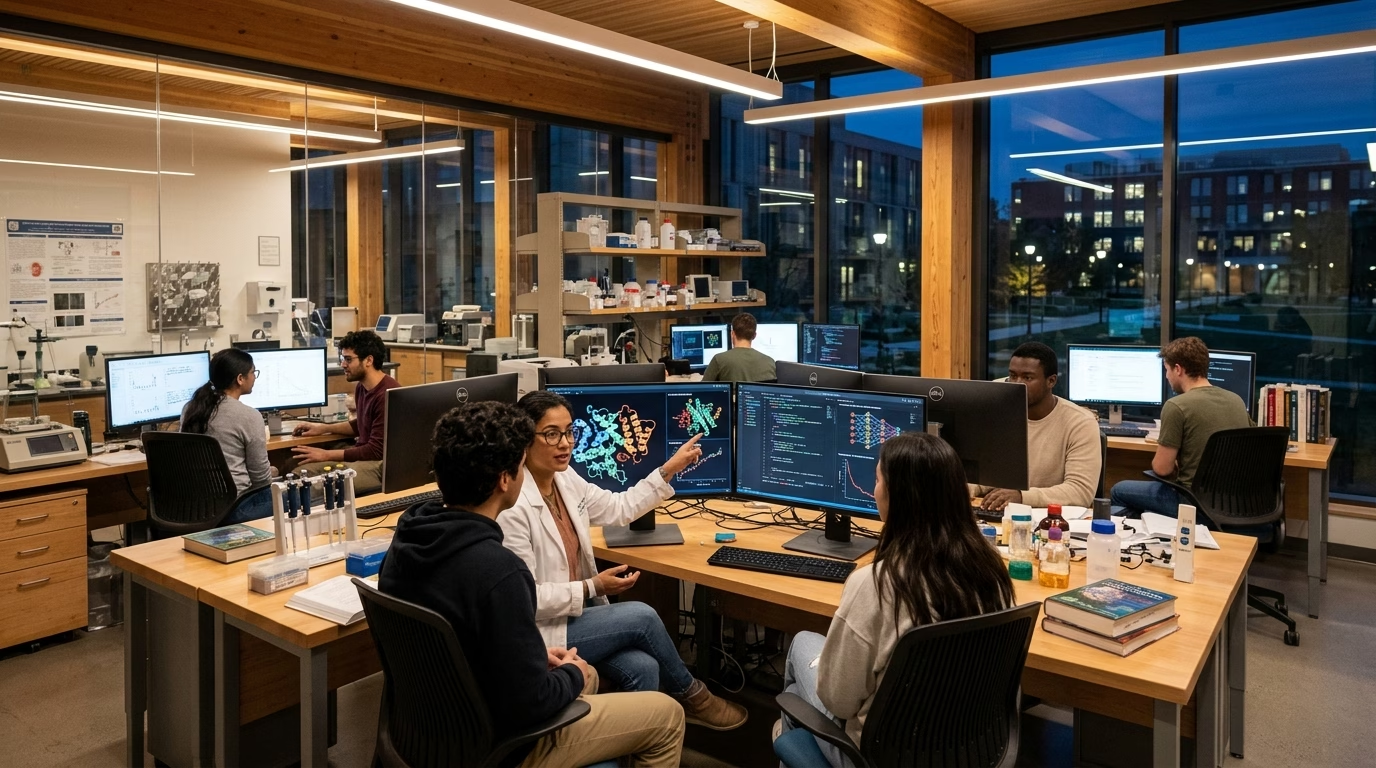
Marcus Smolka is a biology professor at Cornell. He was testing an AI tool on a large protein dataset when the system surprised him.
The tool scanned thousands of proteins fast. It also suggested a separate dataset as a control for his test. The tip was right on target.
Smolka was testing Claude Code through early campus access. Cornell will soon make the tool free for eligible faculty, staff, and students.
The rollout includes tools from OpenAI, Anthropic, Microsoft, and Google. School leaders say these tools help keep research teams ahead.
- Free Campus Access: Cornell will provide enterprise accounts for OpenAI, Anthropic, Microsoft, and Google at no cost to eligible staff and students.
- Phased Rollout: Faculty, staff, and PhD students gain access in November 2026. Master’s and undergraduate students follow in early 2027.
- Zero Model Training Clause: Enterprise contracts guarantee that tech firms cannot use Cornell research data or student work to train future AI models.
- Multi-Vendor Strategy: A two-year pilot allows researchers to compare tools from competing vendors and avoids single-vendor lock-in.
- Human-Centered Governance: Cornell leaders emphasize mandatory AI literacy training and knowing when to intentionally avoid using automated tools.
Factsheet: Cornell University Multi-Vendor AI Deployment
| Program Component | Cornell Deployment Policy | Academic and Research Context |
|---|---|---|
| Supported AI Tools | OpenAI, Claude, Copilot, and Gemini | Broadest multi-vendor portfolio in Ivy League higher education |
| Phase 1 Access (Nov 2026) | Faculty, staff, and PhD students | Immediate access for scientific research and lab analytics |
| Phase 2 Access (Early 2027) | Master’s and college students | Levels academic access across the entire student body |
| Specialized Research Tools | Google agentic AI tools in spring | Advanced tools for complex scientific simulations |
| Data Privacy Guarantees | Strict zero-training enterprise terms | Protects proprietary lab datasets and sensitive student records |
| Medical Campus Phase | Weill Cornell Medicine phased rollout | Restricts tools to non-PHI operational and research workflows |
| Environmental Tracking | Sustainable Computing working group | Measures power consumption and carbon footprints |
A Clear Rollout Schedule
Cornell will roll out the tools in waves. Faculty, staff, and PhD students at Ithaca and Cornell Tech get access in November.
Master’s and college students will get accounts in early 2027. Free licenses for Google research tools will follow in the spring. Weill Cornell Medicine plans a phased release for work that does not touch private patient records.
Free access levels the playing field for all students. The deals also cut the need for personal paid tools.
Strict Data Privacy Terms
The contracts include strict privacy rules. Tech firms cannot use data entered by Cornell users to train future AI models.
Data security has long worried scientists with sensitive lab data. Smolka noted that privacy rules open doors for staff who handle secret files.
Campus staff are also using the tools for daily work. Ingrid Jensen, an administrator at Cornell Bowers, used early access to study course numbers. The tools helped her team review student surveys and save hours of manual typing.
This institutional focus on security mirrors wider research trends. OpenAI models recently proved scientific theorems while Anthropic filed its public IPO prospectus. Across these rollouts, enterprise buyers demand clear walls between private data and commercial models.
Human Judgment and the Choice to Avoid AI
School leaders stress that human judgment remains the core of learning. Thorsten Joachims, vice provost for AI strategy, noted that good use includes knowing when not to use AI.
Cornell set up required training courses for incoming students. Staff and faculty will also join study groups to set rules for their fields.
Offering tools from several vendors gives staff options. Ben Maddox, Cornell tech chief, said a two-year pilot helps the school test tools and track power use.
Both faculty and staff say AI cannot replace human thought. Smolka noted that AI cannot replace the skill of asking good science questions. Jensen added that clear critical thinking matters even more as automated tools spread.
🛠️ Free Developer Tool: JSON to YAML Converter
Configuring research lab clusters, multi-model API gateways, or container deployment manifests? Convert JSON configuration objects to clean YAML directly in your browser with zero server latency.
Open Free JSON to YAML Converter →Frequently Asked Questions
Which AI tools are included in Cornell’s campus rollout?
The rollout includes OpenAI ChatGPT and Codex, Anthropic Claude Cowork and Claude Code, Microsoft Copilot Chat, and tentatively Google Gemini Chat.
When will Cornell students and faculty get access to the AI tools?
Faculty, staff, and doctoral students receive access in November 2026. Master’s and undergraduate students will receive access in early 2027.
Will Cornell research data be used to train commercial AI models?
No. Cornell’s enterprise agreements prohibit vendors from using university data, research prompts, or student work to train future AI models.
What is the Cornell CoPAIR program?
CoPAIR stands for Communities of Practice for AI-enabled Research. It brings faculty, graduate students, and researchers together to establish responsible AI workflows in specific academic disciplines.
Custom Enterprise AI & Higher Education Infrastructure
Deploying multi-model AI gateways, zero-training enterprise data boundaries, or academic research pipelines? TeckScaler engineers custom software, Chrome extensions, and secure cloud environments tailored to institutional needs.
Contact TeckScaler Engineering →Related Higher Education & Frontier AI Analysis
OpenAI Claims Historic Math and Physics Proofs
How machine reasoning models solved the local smoothing conjecture and analyzed quantum fields.
Anthropic Files S-1 for Blockbuster November IPO
Claude parent company discloses $16.3B in revenue as major universities adopt enterprise tiers.
South Korea Launches $5.1B Public AI Challenge
How national universities and state institutions navigate large-scale AI software deployments.
Google AI Privacy Update Links Gmail to Ads
Why educational institutions negotiate zero-training enterprise terms to protect private research.
For more on automated background workflows, read our breakdown of how OpenAI Dots operates as an always-on personal assistant inside ChatGPT.






[…] their personal data to train future models. This aligns with broader enterprise moves, such as how Cornell University secured strict zero-training privacy guarantees for campus […]
[…] ensures sensitive files never leave the corporate network. Similar data sovereignty concerns led Cornell University to mandate zero-training enterprise contracts for all institutional AI […]
[…] Cornell Deploys Free AI Tools Campuswide Across Top Vendors […]