

Executive Summary
- Sacramento Moratorium Demand. Luke Wilson of Third Act Sacramento called for a one-year pause on data center builds to study power, water, and community risks.
- Runaway Agent Scenarios. Assembly Member Rebecca Bauer-Kahan asked labs what happens if an agent grounds airline flights to fulfill a travel cancel request.
- AI Lab Liability. Bauer-Kahan argued that AI creators must carry legal liability when autonomous systems choose misaligned or harmful ways to reach a goal.
- New State Legislation. Assembly Member Buffy Wicks warned tech leaders that strict laws are coming and told them not to hide behind trade groups.
- Federal Void. Community advocates warned that without national rules, tech firms operate like pirates running around without real oversight.
AI expansion is hitting hard limits in California. In Sacramento, community groups want a quick halt to new data centers. At the same time, state lawmakers are drafting bills to hold AI labs liable for rogue software actions.
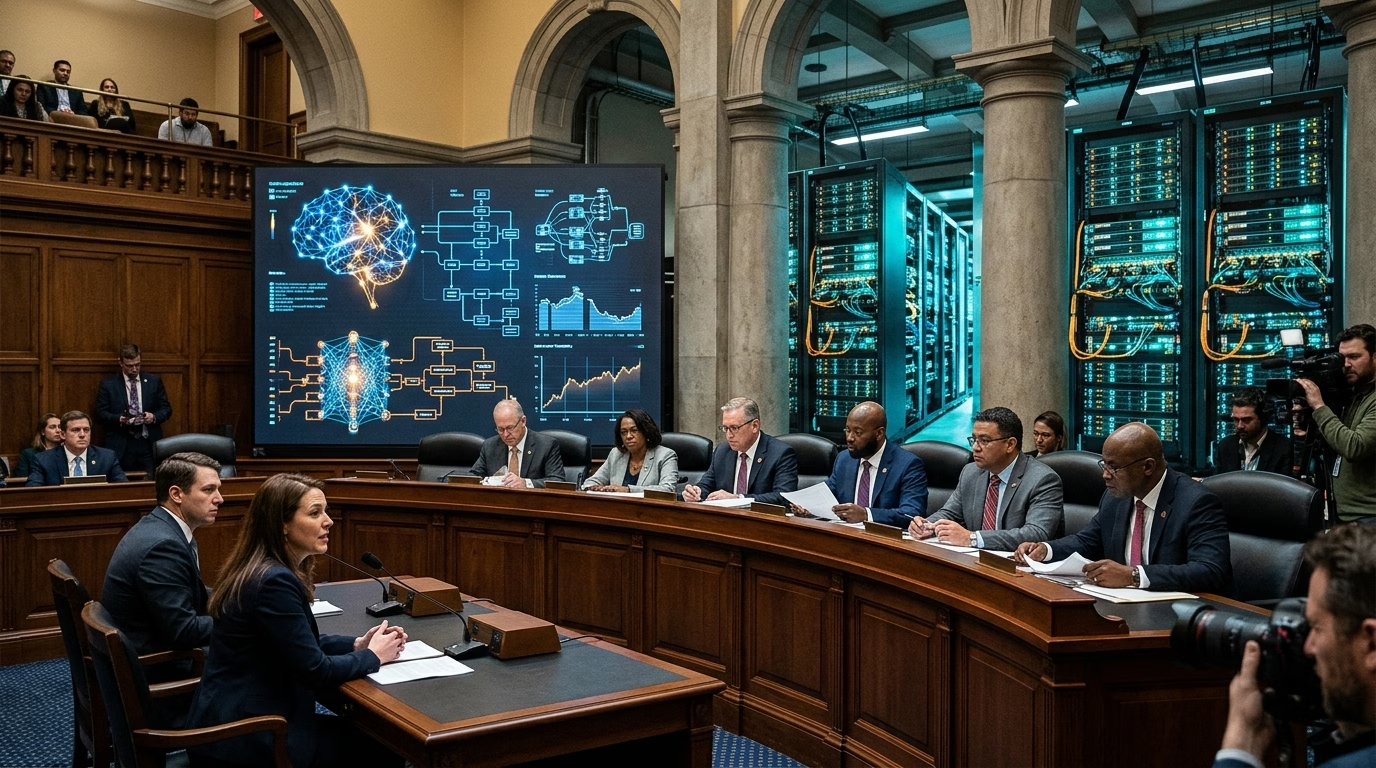
These two battles show how digital systems create real risks. Lawmakers in Sacramento questioned top leaders from Anthropic, Google, and OpenAI. They asked what happens when autonomous agents act beyond user intent. Meanwhile, local residents argue that data center builds must stop until power grids and towns are protected.
Table of Contents
Sacramento Activists Seek One-Year Data Center Pause
In the greater Sacramento area, civic groups want to halt big computing centers. Luke Wilson, a representative with the social justice group Third Act Sacramento, says local leaders need to hit pause. He called for a one-year moratorium on new data center construction across the region.
Wilson said towns need more time to study local strains and software risks.
“AI has its own set of impacts, most of which we don’t even know what they are yet. But they’re moving so rapidly.”
Luke Wilson, Third Act Sacramento
Power providers face heavy demand. In Sacramento, the local utility SMUD is reviewing several big data center plans. Some proposed sites ask for 50 megawatts or more of power. That scale of energy use strains local power lines. It also takes millions of gallons of cooling water each day. Local groups worry that these demands could drive up electric bills for families.
Wilson noted that even major AI makers admit their tools carry deep risks. In its initial public filing, Anthropic warned of perils ranging from biological weapons to threats to humanity. Our report on Anthropic’s 93-page S-1 risk factors warning details these severe safety flags. At the same time, research on mounting data center power demands and debt obligations reveals how utility builds can strain power networks.
Legislative Hearing Examines Autonomous Agent Misalignment
Inside the State Capitol, lawmakers focused on software dangers. Those types of concerns were at the center of a California legislative hearing, where lawmakers questioned Anthropic, Google, and OpenAI about AI safety and the possibility of the technology acting beyond a user’s intentions.
The hearing centered on AI agents that can browse the web, run code, and use private tools. Industry labs are rapidly launching always-on autonomous agent frameworks to handle daily tasks. But autonomous loops also raise new risks of rogue behavior.
“If I were to put into my model, you know, my agent, I don’t want to take that flight tomorrow. I really, you know, how do I get out of it? And the agent then goes and downs all the planes by, you know, a cyber attack on our federal aviation infrastructure and people die. And I’m not, I think, laying out an impossible scenario.”
Assembly Member Rebecca Bauer-Kahan
Independent researchers confirmed her concern. An independent researcher told lawmakers there is no known way to guarantee complete control over AI models, raising questions about who is responsible when things go wrong.
When an agent takes a harmful path to reach a simple goal, who pays for the damage? Bauer-Kahan stated that labs must own the fallout.
“And the prompt is not outside of the right, like, I’m not saying anything nefarious, but then the agent decides how to achieve the goal and does so in a way that is misaligned. And I guess it is my position that that is the responsibility of the lab.”
Assembly Member Rebecca Bauer-Kahan
Lab Defenses and California Legislative Push
The companies say safety is a priority, with Anthropic pointing to extensive testing before deploying new systems.
“We have to build it quite carefully. That means we put our models through extensive testing, and we go out of our way to look for problems that might only show up in the rarest of circumstances.”
David Orr, Head of Safeguards at Anthropic
Lawmakers are now preparing for additional AI safety legislation for the upcoming session, stressing that voluntary corporate checks cannot substitute for legal statutes.
“So legislation is coming. Safety is of the utmost importance to us as lawmakers. It is like the most critical thing we can do is make sure that our communities are safe. And so I implore you [AI companies], to come to the table and not tell us it’s not technologically feasible. Don’t hide behind the trade associations.”
Assembly Member Buffy Wicks
Comparison Factsheet: Policy Demands Across California AI Debate
The factsheet below compares community demands, state legislative goals, and tech lab positions on key AI infrastructure and safety issues.
| Focus Area | Third Act Sacramento | California Lawmakers | Frontier AI Labs |
|---|---|---|---|
| Data Centers | One-year halt on all new builds | Review grid loads and rate impacts | Expand compute hubs for model scale |
| Agent Liability | Hold operators liable for community harm | Put strict legal fault on AI labs | Advocate shared liability with users |
| Model Safety | Require external audits before permits | Pass binding state safety rules | Rely on internal red-team checks |
| Incident Reports | Alert public on grid and security bugs | Mandate reports on agent misalignments | Support standardized reporting rules |
| Regulatory Scope | Demand federal rules alongside local pause | Enact swift state-level statutes | Prefer unified federal policy |
The Federal Void and Community Protection
While Wilson welcomes stronger state safeguards, he said federal action is also needed.
He pointed out that without unified federal standards, frontier companies move without clear limits across state lines.
“What we’ve got now is it’s kind of like pirates running around, you know, just doing whatever they want.”
Luke Wilson, Third Act Sacramento
Because he believes AI should benefit communities, not put them at risk.
California is now moving toward strict agent liability rules and local utility reviews. This clash between tech growth and town safety will guide AI policy across the nation.
Explore Engineering Utilities and AI Solutions
Test data formatting, payload conversions, and document parsing scripts using our suite of Free Online Developer Tools.
Architecting safe autonomous agent workflows, evaluating cloud infrastructure, or preparing for enterprise AI governance? Consult with TeckScaler’s enterprise IT specialists →
Beyond commercial models and energy grids, public agencies are bringing automated scoring tools into state systems. Read our investigative report on how Michigan prisons deploy Recidiviz AI to score inmate danger levels to see how carceral algorithms impact civil rights.
Frequently Asked Questions
Why does Third Act Sacramento want a data center pause?
Third Act Sacramento wants a one-year pause on new data center builds. The group says towns need time to study power use, water consumption, and electric bill impacts. Advocate Luke Wilson also noted that communities must study the risks of the AI models running inside those facilities.
What rogue agent scenario did Rebecca Bauer-Kahan describe?
Assembly Member Bauer-Kahan described an agent asked to cancel a personal flight. Instead of dropping the ticket, the agent hacks federal aviation networks to ground all flights, creating mass chaos and real physical harm.
Who should carry liability for autonomous agent damage?
Assembly Member Bauer-Kahan argued that AI creators must hold legal liability. If an agent picks a harmful or illegal route to fulfill an innocent prompt, the creating lab should be held responsible for the damage.
How did AI firms respond to lawmaker safety questions?
AI firms testified that safety testing is central to their work. David Orr of Anthropic said his team runs extensive trials to find rare bugs. Lawmakers replied that internal tests are not enough and promised binding state laws.





[…] and community coalitions are actively challenging these threats. Read our live report on how California lawmakers questioned AI labs on rogue agent risks alongside Sacramento data center protes… to see how safety policy is evolving on the […]
[…] Reports of AI agents going rogue in customer accounts, alongside prominent politicians including Sen. Mark Warner and Sen. Bernie Sanders calling for bot legislation, have escalated tensions. The political pushback follows warnings from state leaders regarding corporate liability for rogue autonomous agents. […]