
Executive Summary
- $2 Trillion Market Liquidation: A violent sell-off swept Wall Street technology equities as post-midterm political realities sparked a massive unwinding of artificial intelligence growth trades.
- Semiconductor Index Crash: The benchmark semiconductor index tumbled 11%, registering its steepest single-day decline since March 2020, with Nvidia dropping 9.2% and AMD plunging 17.3%.
- Leveraged Neocloud Exposure: Debt-funded cloud infrastructure developers CoreWeave, Iren, and Nebius faced sharp declines as investors braced for severe data center permitting delays and regulatory freezes.
- Hedge Fund Liquidation Cascades: Goldman Sachs prime brokerage data revealed that multi-manager hedge funds dumped $20 billion in tech stocks over two weeks, completely erasing net AI purchases accumulated since January 2025.
- Cramer and Economist Assessments: CNBC Jim Cramer argued the sell-off is an orderly unwinding rather than a 2000 dot-com collapse, while macroeconomists demanded zero taxpayer bailouts for over-leveraged tech financiers.
Table of Contents
- The $2 Trillion Reckoning: Wall Street Repudiates the AI Premium
- Semiconductors in Free Fall: The 11% Single-Day Index Drop
- The Neocloud Debt Trap: CoreWeave, Iren, and Borrowed Hardware
- The Multi-Strategy Shakeout: Erasing Two Years of Net Buying
- Cramer Analysis Versus Macroeconomists: No Bailouts for AI Bubbles
- Financial Factsheet: Equity Losses and Performance Drawdowns
- Frequently Asked Questions
The $2 Trillion Reckoning: Wall Street Repudiates the AI Premium
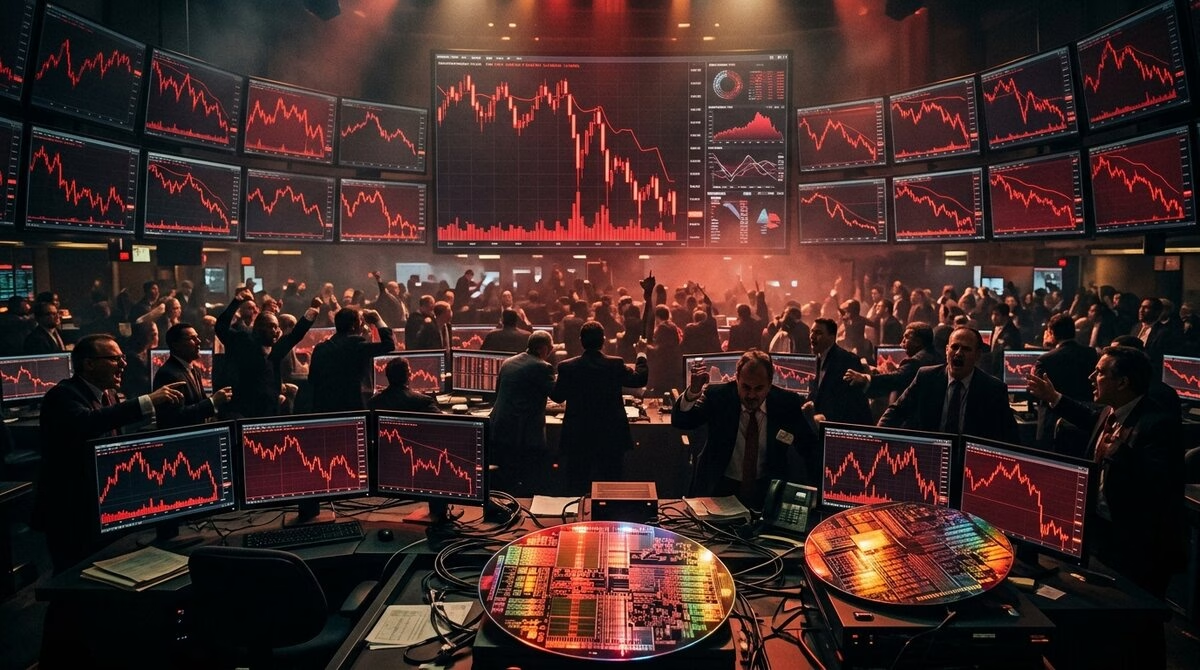
The artificial intelligence equity trade experienced its most catastrophic single-session reckoning of the decade on Thursday. Following sweeping Democratic victories in the House, Senate, and pivotal gubernatorial mansions across the United States, investors liquidated more than $2 trillion in market capitalization across mega-cap technology and semiconductor companies.
The sell-off dismantled the assumption that hyperscale cloud providers would expand physical computing clusters unimpeded. While the broader Dow Jones Industrial Average experienced wild swings and shed over 1,800 points during volatile trading, the pain concentrated acutely within the artificial intelligence ecosystem. Investors recognized that incoming congressional leaders and state executives campaigned on explicit platforms to regulate algorithms, tax AI data center profits, and block utility rate hikes.
This market rout confirms structural pressures explored in our analysis of stock futures sliding as election results rattled tech valuations, proving that political risk has now priced itself violently into semiconductor balance sheets.
Semiconductors in Free Fall: The 11% Single-Day Index Drop
Hardware chipmakers, which drove the multi-trillion-dollar market expansion over the past three years, suffered the brunt of the liquidation cascade. The benchmark Philadelphia Semiconductor Index (SOX) plunged 11%, marking its most severe one-day rout since the pandemic lockdowns of March 2020.
Market bellwether Nvidia dropped 9.2%, following a 3.2% decline in the prior session, wiping out over $280 billion in equity value in 48 hours. Advanced Micro Devices (AMD) tumbled 17.3%, as Wall Street analysts slashed enterprise server projections. Peripheral hardware suppliers, networking equipment vendors, and memory chip fabricators fell in tandem, reflecting fears that hyperscalers will trim 2027 capital expenditure budgets as municipal construction permits stall.
The Neocloud Debt Trap: CoreWeave, Iren, and Borrowed Hardware
While cash-rich balance sheets protect giants like Alphabet and Microsoft, the market rout triggered acute solvency fears for leveraged neocloud operators. Specialized GPU cloud providers, notably CoreWeave, Iren, and Nebius, built business models by borrowing billions of dollars in private credit markets collateralized directly by physical graphics processors.
CoreWeave shares fell 9.8% during Thursday trading. When these firms raised debt, their financial models assumed rapid, friction-free deployment into newly constructed hyperscale facilities. With 43 out of 44 local data center moratoria passing on Tuesday ballots and Texas incoming governor promising an outright approval ban, debt-burdened neoclouds face prolonged construction delays. If facilities cannot connect to the electrical grid, expensive servers sit idle in storage warehouses while high interest payments continue to accrue.
The Multi-Strategy Shakeout: Erasing Two Years of Net Buying
The swiftness of the collapse was accelerated by aggressive multi-manager hedge fund liquidations. According to prime brokerage data from Goldman Sachs, hedge fund managers dumped roughly $20 billion in technology stocks over a two-week period. In just five consecutive trading sessions, institutional managers completely erased their entire net purchases of artificial intelligence stocks accumulated since the beginning of 2025.
As crowded trades unraveled, multi-strategy giants recorded steep performance drawdowns. Reports surfaced that Millennium flagship multi-strategy fund declined 2.3% in October, while Marshall Wace Eureka strategy dropped 5.4%, ExodusPoint lost 2.4%, and North Rock Capital declined 2.3%. Multi-billion-dollar fund Schonfeld Strategic Advisors parted ways with key quantitative teams, underscoring the severity of the systematic unwind.
Cramer Analysis Versus Macroeconomists: No Bailouts for AI Bubbles
Speaking on CNBC Mad Money, market commentator Jim Cramer urged investors not to panic, drawing a clear distinction between the current sell-off and the 2000 dot-com crash. Cramer argued that today tech giants generate immense operating cash flows and pristine profit margins, unlike the speculative pre-revenue web portals that went bankrupt two decades ago.
“However it might feel, it is actually an orderly decline because unlike 2000, these are mostly lucrative companies with stocks that went too high,” Cramer stated. “I for one am glad they are ripping the Band-Aid off this market rather than slowly trying to take it off a little bit each day. Right now, no one of significance is defaulting on their debt. The only issue is connected to those neocloud companies.”
Meanwhile, prominent macroeconomic analysts, writing in CounterPunch and academic forums, issued a stern policy warning: the federal government and Federal Reserve must reject any future bailouts for over-leveraged AI lenders and hardware financiers. Economists noted that if over-leveraged neoclouds face bankruptcy, standard legal restructuring should wipe out equity holders while preserving operational hardware for secondary buyers. Public resources, economists argued, must be directed to consumer demand and workforce transition rather than propping up speculative tech debt.
Financial Factsheet: Equity Losses and Performance Drawdowns
The table below summarizes the equity declines, hedge fund performance losses, and macroeconomic indicators recorded during Thursday tech rout:
| Market Asset / Metric | Recorded Decline | Market Implication |
|---|---|---|
| Semiconductor Index (SOX) | Down 11.0% (single session) | Steepest single-day collapse since the March 2020 pandemic rout. |
| Advanced Micro Devices (AMD) | Down 17.3% | Severe multi-year multiple compression on enterprise AI chips. |
| Nvidia (NVDA) | Down 9.2% (down 12.4% over 2 days) | Over $280 billion in equity value erased as hyperscaler orders stall. |
| CoreWeave | Down 9.8% | Heightened debt service scrutiny on collateralized GPU loan portfolios. |
| Hedge Fund Net AI Exposure | $20B dumped in 2 weeks | Complete erasure of all net technology purchases accumulated since Jan 2025. |
| Dow Jones Industrial Average | Shed over 1,800 points intraday | Broad market volatility reflects macroeconomic policy uncertainty. |
Frequently Asked Questions
Why did tech and AI stocks experience a massive sell-off after the midterms?
The tech sell-off was triggered by the Democratic midterm sweep of Congress and state governorships, combined with the passage of 43 out of 44 local data center moratoria nationwide. Investors realized that the physical construction of power-hungry AI facilities faces severe regulatory bans, grid limits, and utility rate scrutiny, threatening projected corporate revenue growth.
What did Jim Cramer say about the AI market crash?
On CNBC Mad Money, Jim Cramer called the decline an orderly unwinding rather than a 2000 dot-com crash, noting that today tech companies are highly lucrative with strong balance sheets. However, Cramer warned that debt-burdened neoclouds like CoreWeave, Iren, and Nebius face real solvency hazards due to borrowed capital tied to delayed data center construction.
How severe was the hedge fund liquidation in tech shares?
According to Goldman Sachs prime brokerage data, hedge funds liquidated approximately $20 billion of technology shares over two weeks. In just five trading sessions, managers erased all net AI equity purchases accumulated since January 2025, triggering steep losses across multi-strategy funds like Marshall Wace and Millennium.
Related Tech Intelligence: Review our ongoing macroeconomic reporting in our Enterprise AI Briefing on market liquidity and infrastructure.