

Executive Summary
- UCL Academic Spinout. University College London spun out Octopath AI, a computational pathology company building foundation models to guide precision cancer care.
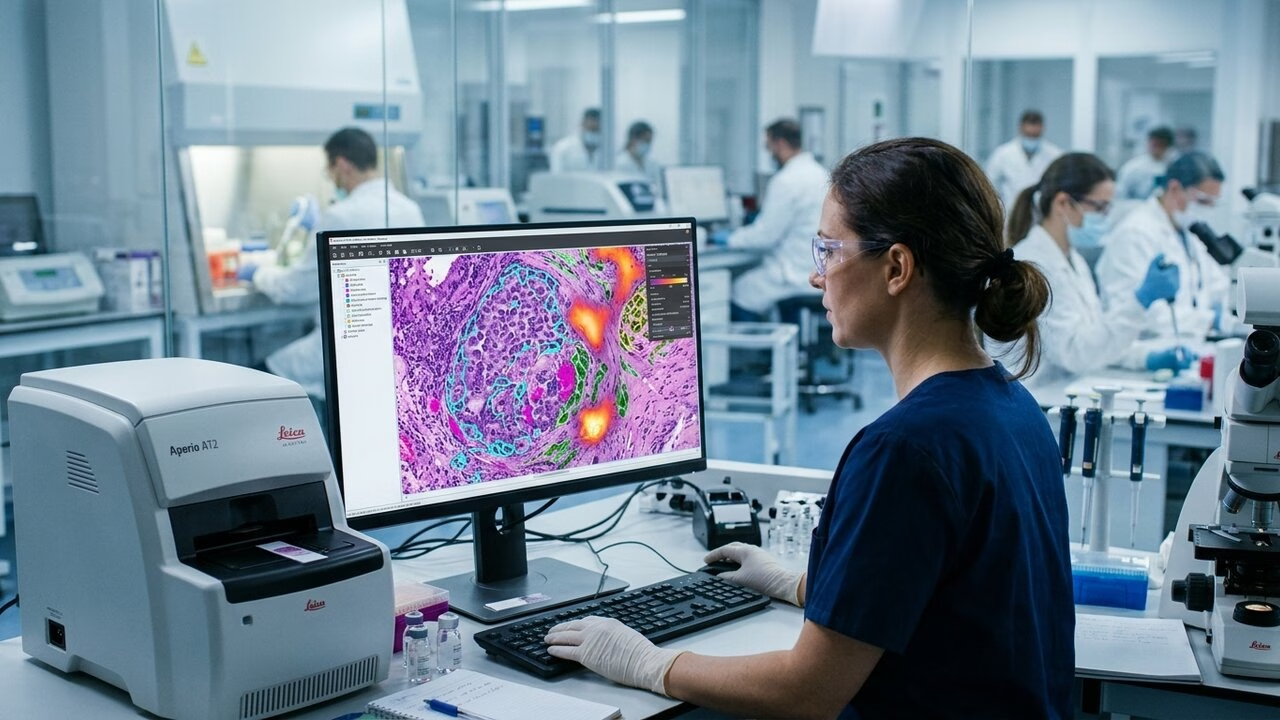
- Two-Minute Analysis. The platform analyzes routine biopsy tissue slides at single-cell resolution in under two minutes, measuring tumor cells and surrounding immune infiltration.
- Foundational AI Models. Octopath built Kraken for standard hematoxylin and eosin (H&E) slides across multiple organs, alongside Nemo for immunohistochemistry staining quantification.
- Bypassing Genetic Delays. By extracting hidden immune signatures from routine glass slides, the tool provides prognostic insights without the multi-week waits and high costs of whole-genome sequencing.
- £1.5M Seed Capital. TwinPath Ventures led the seed financing round, supported by a matched £500,000 Innovate UK Growth Catalyst grant to drive NHS clinical trials.
Pathology labs face a critical staffing squeeze. Cancer diagnoses are climbing worldwide, yet medical teams still examine tissue slides manually under microscopes. A new university spinout wants to solve that bottleneck using artificial intelligence.
University College London launched Octopath AI, a biomedical startup spun out of its Department of Medical Physics and Biomedical Engineering. The company closed a £1.5 million funding round to deploy machine learning models that read cancer biopsies in less than two minutes.
Rather than replacing doctors, the software serves as a digital assistant. It maps whole tissue slides at single-cell resolution, uncovering biological patterns that predict how a patient will respond to oncology treatments.
Table of Contents
- The Diagnostic Crunch: Rising Cancer Cases and Staffing Shortages
- Foundation Models: How Kraken and Nemo Read Biopsy Slides
- Unlocking Hidden Signatures: Predicting Drug Response Without Gene Sequencing
- Factsheet: Comparing Diagnostic Workflows in Cancer Pathology
- Commercial Roadmap: TwinPath Backing, Innovate UK, and NHS Deployments
- Frequently Asked Questions
The Diagnostic Crunch: Rising Cancer Cases and Staffing Shortages
Pathologists examine tissue samples to confirm cancer diagnoses and assess tumor severity. In recent years, diagnostic workloads have surged due to aging populations and earlier screening programs. At the same time, hospitals face severe specialist shortages.
Manual slide review also suffers from human variation. Two experienced doctors can view the same biopsy and arrive at differing estimates of immune cell infiltration or cell density. These visual estimates directly shape whether a patient receives chemotherapy, surgery, or targeted immunotherapy.
Octopath AI aims to standardize this process. By processing digital whole-slide images, its software calculates exact cell counts and spatial relationships across millions of individual cells.
“Pathology slides are already part of routine care, so they are an abundant source of data. We predicted that we could extract valuable information about a patient’s tumour from these slides using AI, which has become very good at analysing medical images in recent years, and link this to patient outcomes.”
Dr. Charles-Antoine Collins-Fekete, Co-Founder of Octopath AI and UKRI Future Leaders Fellow at UCL
Foundation Models: How Kraken and Nemo Read Biopsy Slides
The startup built its technical edge on two primary foundation models: Kraken and Nemo. Unlike older software that required custom training for every organ, these systems generalize across diverse tissue types.
- Kraken (H&E Model): Evaluates standard hematoxylin and eosin slides. The model trained on millions of labeled cells across breast, lung, colon, brain, and liver tissues. It segments and classifies cells without retraining for individual organs.
- Nemo (IHC Model): Evaluates immunohistochemistry slides. The engine identifies cell classes, assesses staining positivity, and scores protein intensity for targeted biomarkers.
- Rapid Turnaround: Analyzes complete gigapixel slide scans in under two minutes, fitting neatly into daily hospital workflows.
- Spatial Mapping: Maps tumor margins and immune lymphocyte boundaries to measure how immune defenses interact with malignant cells.
This speed enables real-time decisions during multi-disciplinary tumor boards. Doctors can review quantitative cell counts while planning surgery or drug schedules, rather than waiting days for secondary manual staining.
Unlocking Hidden Signatures: Predicting Drug Response Without Gene Sequencing
Modern oncology relies heavily on precision medicine. Doctors want to know whether a patient will respond to expensive immunotherapies before starting grueling treatment rounds. Currently, hospitals gather these answers through whole-genome sequencing.
However, genomic sequencing carries major drawbacks. Tests cost thousands of pounds per patient. They require specialized lab equipment and often take two to four weeks to return results. For patients with aggressive cancers, that delay can be dangerous.
“While experienced pathologists can recognise some immune features of the tumour microenvironment, this information is not routinely used to inform treatment. The AI approach identifies these hidden immune signatures directly, offering a level of biological insight normally only attainable through methods like whole-genome sequencing, which is expensive, technically demanding, and not currently used in the clinic except for late-stage rectal cancer patients.”
Dr. Zhuoyan Shen, Co-Founder of Octopath AI and Researcher at UCL
In clinical studies published in eBioMedicine, researchers demonstrated that Octopath’s algorithms predict therapy response in rectal cancer patients. By analyzing immune cell patterns surrounding the tumor, the model matched the prognostic precision of genomic tests using simple glass slides that cost pennies to prepare.
Factsheet: Comparing Diagnostic Workflows in Cancer Pathology
The following table compares conventional pathology, genomic sequencing, and Octopath AI’s digital platform:
Commercial Roadmap: TwinPath Backing, Innovate UK, and NHS Deployments
Octopath AI launched with backing from venture capital and public research grants. The £1.5 million package includes a seed round led by TwinPath Ventures, an investor focused on AI-native startups. It also includes a matched £500,000 Growth Catalyst grant from Innovate UK.
The spinout emerged through UCL Business (UCLB), the commercialization arm of the university. The underlying science grew out of a UKRI Future Leaders Fellowship led by Dr. Collins-Fekete, alongside co-founders Dr. Zhuoyan Shen and Dr. Esther Bär.
The company will use the capital to expand multi-center clinical trials across the NHS, including ongoing evaluations at University College London Hospitals (UCLH). The team is also preparing regulatory dossiers for CE and UKCA medical device certification.
This clinical milestone reflects a broader trend toward verified digital health infrastructure. Just as consumer healthcare platforms like Zocdoc opened verified scheduling networks to AI agents, oncology diagnostics is shifting toward automated, auditable data pipelines. By giving doctors quantitative cell data in minutes, Octopath AI brings precision oncology directly into everyday patient care.
Single-cell biology is also shifting to conversational tools. Read our report on how 10x Genomics launched Sentira Single Cell powered by Anthropic’s Claude to compress weeks of genomic analysis into hours.
Frequently Asked Questions
What is Octopath AI?
Octopath AI is a medical software spinout from University College London. The company develops foundation machine learning models that analyze cancer biopsy slides in under two minutes to assist pathologists and predict treatment response.
What are the Kraken and Nemo models?
Kraken is a foundation cell model that analyzes standard hematoxylin and eosin (H&E) slides across multiple tissue types without retraining. Nemo evaluates immunohistochemistry (IHC) slides, measuring cell classes, staining intensity, and protein biomarkers.
How does the software predict cancer treatment response?
The platform maps the tumor microenvironment at single-cell resolution. It calculates the density and spatial distribution of immune cells around tumors, uncovering hidden signatures that indicate whether drugs will succeed.
Why is this an alternative to whole-genome sequencing?
Whole-genome sequencing is costly and takes several weeks to deliver results. Octopath extracts equivalent prognostic insights directly from routine biopsy glass slides in under two minutes at a fraction of the cost.
Who funded Octopath AI?
Octopath AI raised £1.5 million in seed capital and grants. The round was led by TwinPath Ventures with support from a £500,000 matched Growth Catalyst grant from Innovate UK.



[…] launch matches a broader industry pivot toward single-cell automation. Earlier today, UCL spinout Octopath AI raised £1.5M for cancer biopsy pathology using single-cell foundation models. Across genomics and pathology, artificial intelligence is […]
[…] in precision pathology. Similar computational breakthroughs were highlighted in our coverage of how UCL spinout OctoPath AI accelerates automated cancer pathology, showing how deep learning models are unlocking patient-specific genomic insights directly from […]