

Executive Summary
- Agentic Genomics Software. Life sciences leader 10x Genomics launched Sentira Single Cell, a cloud application powered by Anthropic’s Claude models to analyze Chromium sequencing datasets.
- Weeks into Hours. The agentic chat system writes custom bioinformatics code, runs pipelines in parallel on 10x Cloud, and cuts multi-week data exploration cycles down to hours.
- Virtual Lab Origins. Built in partnership with Stanford Professor James Zou, Sentira adapts algorithms from the landmark 2025 Nature Virtual Lab study into commercial biology tools.
- The Silent Mistake Debate. Leading geneticists warn that while AI code runs smoothly and produces attractive plots, the technology cannot feel when data patterns look suspiciously tidy.
- Consumption Credit Model. Analysis operates via 10x Cloud Credits, costing roughly 12 credits per agent session and 60 credits for complete experimental conclusions.
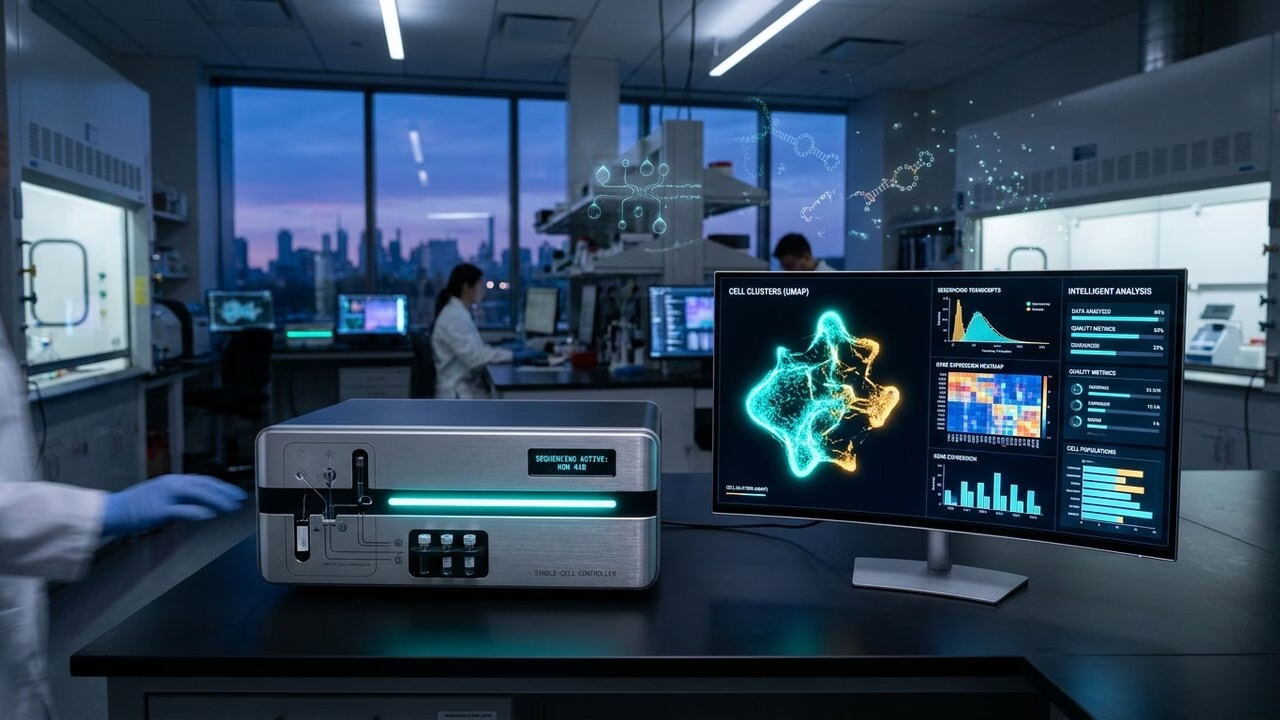
Single-cell biology generates massive datasets, but analyzing that data remains an exhausting hurdle. Biologists often spend weeks writing custom code to cluster cells and interpret RNA expression. Now, 10x Genomics is handing that burden to autonomous AI agents.
The life sciences hardware leader launched Sentira Single Cell, a cloud analysis tool powered by Anthropic’s Claude models. Built for users of its flagship Chromium platform, Sentira allows biologists to explore complex genetic data using simple text prompts.
The system tackles the field’s chronic last-mile problem. Rather than waiting for bioinformatics teams to write scripts, researchers can chat directly with their experiments on 10x Cloud.
Table of Contents
- The Last-Mile Problem: Why Single-Cell Analysis Stalled in Code
- From Stanford’s Virtual Lab to 10x Cloud: How Sentira Works
- The Peril of Silent Mistakes: Why Scientists Urge Caution
- Factsheet: Comparing Single-Cell Bioinformatics Workflows
- Pricing and Packaging: 10x Cloud Credits Structure
- Frequently Asked Questions
The Last-Mile Problem: Why Single-Cell Analysis Stalled in Code
Single-cell RNA sequencing isolates thousands of individual cells to measure gene activity. The technology revolutionized cancer biology, immunology, and neuroscience. Yet analyzing the resulting data required advanced programming skills in R or Python.
Every research question is unique. Because off-the-shelf software could not handle every custom workflow, wet-lab biologists faced long queues waiting for bioinformaticians to build custom scripts. 10x Genomics Chief Technology Officer Michael Schnall-Levin described this as a long-standing roadblock.
“Ask any single cell researcher for their biggest experimental bottlenecks, and they will say data analysis. Going back to the beginning of the field, there has always been a last mile problem. What might have taken someone weeks before could take hours.”
Michael Schnall-Levin, PhD, Chief Technology Officer at 10x Genomics
With Sentira, the company hopes to democratize data discovery. Researchers without coding skills can question their datasets directly, spotting cellular patterns that manual reviews overlook.
From Stanford’s Virtual Lab to 10x Cloud: How Sentira Works
The architecture behind Sentira grew out of academic research. In early 2026, 10x Genomics collaborated with Dr. James Zou, Associate Professor of Biomedical Data Science at Stanford University. Zou pioneered the Virtual Lab framework, which was first demonstrated in a 2025 Nature paper on AI-designed SARS-CoV-2 nanobodies.
Sentira operates on 10x Cloud, supplying managed computing power without server configuration headaches. The platform features an agentic workflow:
- Natural Language Dialogue: Biologists type biological questions in everyday English, asking the system to find differentially expressed genes or identify rare immune subtypes.
- Autonomous Scripting: In the background, Claude generates and runs Python and R analysis code specifically tailored to Chromium data structures.
- Parallel Execution: The cloud engine spins up compute instances to run multiple clustering tests and statistical verifications at the same time.
- Strict Data Privacy: 10x Genomics monitors system telemetry to improve software responsiveness, but confirmed that customer genomic data never flows back into model training.
Early adopters note that foundation model tools are advancing fast. Dr. Henry Long, Scientific Director at the Dana-Farber Cancer Institute, noted that 10x must continue updating Sentira to match general frontier tools like Anthropic’s Claude Science and OpenAI’s Rosalind.
The Peril of Silent Mistakes: Why Scientists Urge Caution
Despite the massive productivity leap, leading scientists urge careful oversight. The primary danger with automated bioinformatics is that machine-generated results rarely look broken.
Dr. Luciano Martelotto, Director of Global Market Development for Single Cell at Waters Biosciences, warned about the psychological trap of clean outputs. AI software does exactly what researchers ask, but it lacks the scientific skepticism that spots false positives.
“Nothing in an AI-generated analysis looks broken. The code runs, the plots are pretty, the story makes sense. The mistakes that matter are the silent ones. What it doesn’t do is get that uneasy feeling when a result looks too good. That feeling comes from having watched data go wrong, and I don’t think it can be prompted or coded into existence, not yet, at least.”
Dr. Luciano Martelotto, Single Cell Market Development Director at Waters Biosciences
Dr. Holger Heyn of the Centro Nacional de Análisis Genómico echoed this concern. He pointed out that while AI can cluster millions of cells, models still struggle with the genuine biological variation found in living human tissue.
Factsheet: Comparing Single-Cell Bioinformatics Workflows
The following table outlines how Sentira Single Cell compares to manual scripting and generalized language models:
Pricing and Packaging: 10x Cloud Credits Structure
Sentira uses a consumption-based pricing model powered by 10x Cloud Credits. A standard exploration session costs roughly 12 credits. Reaching final experimental conclusions typically requires around 60 credits.
To encourage trial, 10x Genomics grants 100 free credits with every user’s first uploaded Chromium dataset. Ongoing credit packs feature tiered volume discounts:
- 100 Credit Pack: $120 ($1.20 per credit)
- 1,000 Credit Pack: $1,150 ($1.15 per credit)
- 2,000 Credit Pack: $2,200 ($1.10 per credit)
- 10,000 Credit Pack: $10,500 ($1.05 per credit)
- 25,000 Credit Pack: $25,000 ($1.00 per credit)
This launch matches a broader industry pivot toward single-cell automation. Earlier today, UCL spinout Octopath AI raised £1.5M for cancer biopsy pathology using single-cell foundation models. Across genomics and pathology, artificial intelligence is transforming raw biological samples into rapid clinical answers.
Automated agents are also expanding into corporate treasuries. Read our analysis on how Aion launched an autonomous AI agent across business banking and payments to handle bill payments, credit lines, and corporate banking under strict human controls.
Frequently Asked Questions
What is 10x Genomics Sentira Single Cell?
Sentira Single Cell is a cloud-based agentic software tool powered by Anthropic’s Claude models. It allows Chromium platform users to explore and analyze single-cell RNA datasets using conversational chat rather than manual scripting.
How much faster is Sentira compared to traditional analysis?
10x Genomics estimates that analyses that previously required two to four weeks of custom programming can now be completed in a few hours through automated code generation on 10x Cloud.
Is customer genomic data used to train AI models?
No. 10x Genomics confirmed that while application performance metrics are tracked to optimize software speed, customer genomic data does not flow back into training Anthropic’s Claude models.
What are the primary scientific concerns about AI genomics?
Scientists caution against silent mistakes, where machine-generated code and visualizations appear flawless but hide biological false positives. Researchers emphasize that human verification remains essential before publication.
How much does Sentira Single Cell cost?
Pricing uses 10x Cloud Credits starting at $1.20 per credit down to $1.00 for bulk packs. Standard sessions cost roughly 12 credits, and complete analyses cost approximately 60 credits. First-time uploads include 100 promotional credits.








[…] biology is also shifting to conversational tools. Read our report on how 10x Genomics launched Sentira Single Cell powered by Anthropic’s Claude to compress weeks of genomic analysis into […]