
Executive Summary
- Regulatory Blind Spot. Federal buying rules state who holds authority to make choices. They set no rules for using AI in bid reviews.
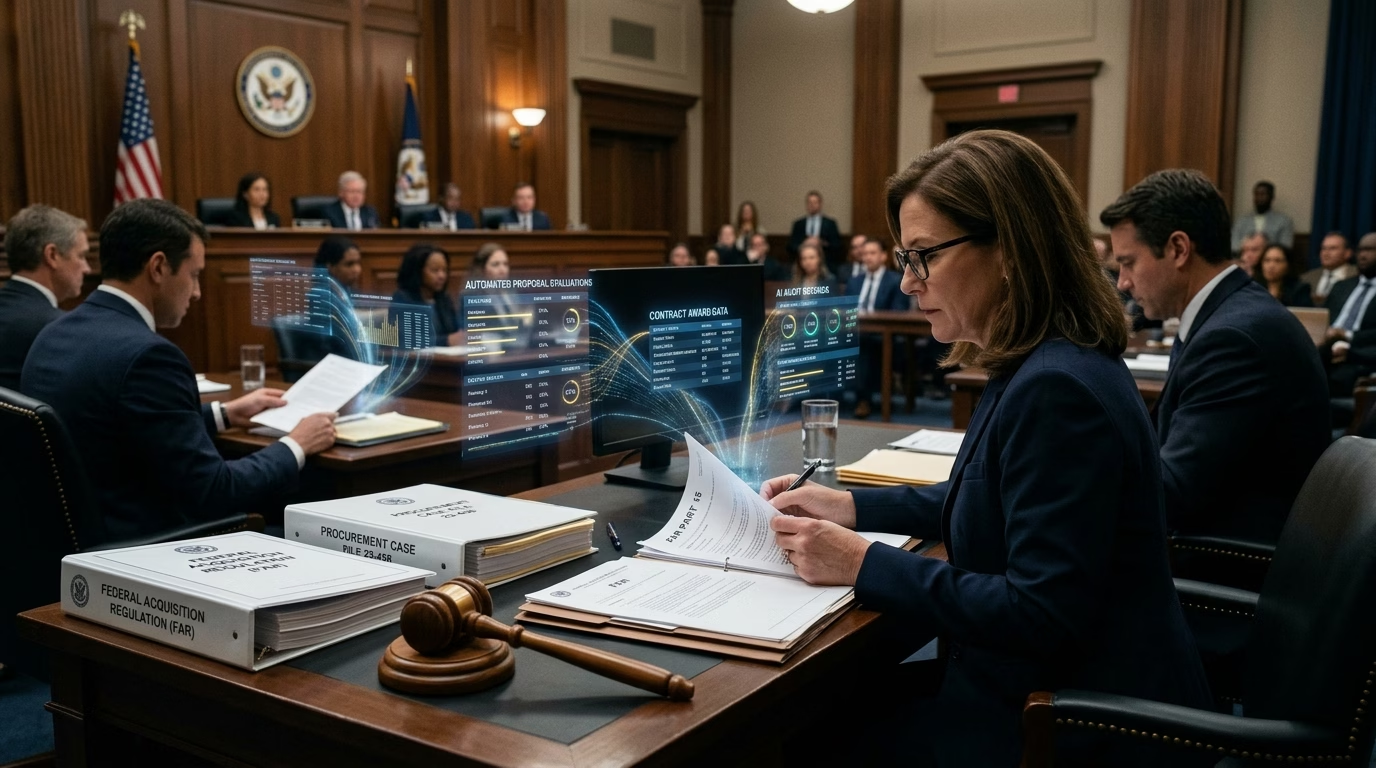
- Court of Federal Claims Order. In a bid protest by TRAX International against the Army, a federal judge ordered officials to file all AI proposal reviews in court. The order stands even if staff say they discarded the files.
- Three Key Safeguards. Legal scholars and software vendors want mandatory AI tool disclosure, human sign-off on scores, and contract file logging.
- White House Overhaul. The push comes as the FAR Council carries out an executive order to streamline federal purchasing rules.
Federal purchasing faces a major turning point. Legal experts want the FAR Council to set firm AI rules. Right now, agencies use AI tools to review contract bids. But current rules do not say how they can use them.
In September, the FAR Council proposed four new rules. Public comments closed on October 19. Experts say the council must act now. Without clear rules, agencies and vendors face rising legal risks.
Table of Contents
The Regulatory Vacuum in Federal AI Procurement
Billions of dollars flow through federal contracts every year. Today, no federal rule explains how buyers may use AI to review bids or check prices. Current rules state who has the legal power to make decisions. But they stay silent on automated software.
This silence causes problems. Agencies test automated tools to read thick proposals. Questions over automated systems also mirror recent congressional probes into autonomous company management. Without clear rules, each office decides how much AI can shape multi-million dollar awards.
The TRAX v. Army Lawsuit: Errors and the Court Record
The push for rules gained steam after a major bid fight. In August, TRAX International challenged an Army award for White Sands Missile Range support services. The contractor claimed false AI outputs damaged its technical score. It asked the U.S. Court of Federal Claims to order a full reevaluation.
Army lawyers countered that the AI reports were faulty. They claimed staff never placed the reports into the contract file or used them in final choices. Judge Matthew Solomson issued an important ruling. He found that TRAX did not prove the Army leaned too hard on AI to make the award arbitrary.
Yet the judge ordered the Army to turn over all AI-generated bid reviews. He required the service to place them in the official court record. The ruling set a vital precedent. Agencies cannot hide AI outputs by claiming they discarded them. Any tool an agency uses during review belongs in the public record.
Comparison Factsheet: Current FAR vs. Proposed AI Standards
The table below compares current federal buying rules with the new standards sought by industry experts.
| Rule Dimension | Current FAR Framework | Proposed AI Standards |
|---|---|---|
| Tool Disclosure | No disclosure needed. Offices score bids without naming tools. | Mandatory disclosure of AI tools and their exact roles. |
| Score Checks | General agency discretion with no required software checks. | Mandatory human sign-off on every AI score. |
| File Logging | Offices only log final choices. Machine notes are left out. | Full logging of AI findings and final staff decisions. |
| Court Records | Disputed. Offices treated AI reviews as private draft notes. | Mandatory inclusion of all AI reviews in the record. |
| Vendor Rights | Tough barriers. Bidders cannot view automated scoring data. | Clear right to inspect AI scoring and find errors. |
Legal and Industry Demands: Three Core Guardrails
In a letter obtained by Federal News Network, Alan Chvotkin of Protorae Law urged the council to act. Protests over AI tools are growing at the Government Accountability Office and in federal court. Chvotkin laid out three mandatory safeguards.
- Tool Disclosure: Agencies must disclose which AI tools they use. They must describe how each tool assists in bid scoring.
- Human Sign-Off: A human official must check every AI output. That official must formally adopt or reject each score.
- File Logging: Staff must log every machine finding in the contract file. They must record the human decision alongside it.
Tech vendors also want clear rules. GovSignals builds AI software for federal deals. The firm sent its own letter urging governmentwide standards for bid scoring, price checks, and file records. GovSignals noted that buyers already use automated tools in live selections. Setting standards now gives officers clear rules and protects public trust.
The Trump FAR Overhaul Mandate and What Lies Ahead
The push for AI rules arrives during a major regulatory overhaul. President Donald Trump ordered the Office of Federal Procurement Policy and the FAR Council to review all buying rules. The goal is to drop unnecessary rules and keep provisions required by statute.
Experts argue that clear AI rules fit this mission. Resolving AI review rules early prevents costly lawsuits and builds vendor trust. Similar debates over automated systems divide leaders across the country. Recent reports reveal how AI oversight divides Congress and impacts the workforce. The FAR Council will soon decide whether to add AI guardrails as it finishes its new rules.
Explore Engineering Utilities and AI Solutions
Test formatting, token efficiency, and text processing workflows using our suite of Free Online Developer Tools.
Building secure, compliant AI pipelines or auditing automated procurement workflows for your business? Consult with TeckScaler’s enterprise IT specialists →
Frequently Asked Questions
What is the FAR Council and why does its guidance matter?
The Federal Acquisition Regulatory Council oversees federal purchasing rules. Its policies guide how agencies spend hundreds of billions in taxpayer funds each year.
What occurred in the TRAX lawsuit against the Army?
TRAX sued after the Army picked a rival for White Sands missile range services. TRAX claimed AI errors hurt its score. The court ordered the Army to place all AI review files into the record.
Can federal agencies use AI to score bids today?
Current rules do not ban AI tools. But they lack clear rules on how staff may use them. Contracting officers make final calls, but guidelines omit required disclosure or logging steps.
What safeguards do legal and industry experts propose?
Experts propose three main safeguards. They urge mandatory tool disclosure, human sign-off on scores, and permanent file logging.