

Executive Summary
- From Motion Triggers to Deep Vision. Traditional pixel motion detectors produce up to 95 percent false alarms. Neural networks analyze actual shapes and movement vectors to cut junk alerts.
- Edge Inference Slashes Bandwidth. Streaming 20 4K cameras to the cloud requires 160 Mbps of steady uplink. Running models locally on edge accelerators reduces outbound traffic by over 95 percent.
- Real-Time Detection and Tracking. Modern setups pair fast detectors like YOLOv10 with tracking algorithms like ByteTrack. This setup tracks objects through temporary blockages and visual clutter.
- Spatial Analytics Beyond Bounding Boxes. Advanced deployments monitor directional tripwires, zone dwell times, loitering counters, and crowd densities without human operators.
- Privacy by Design. Edge hardware can blur human faces and license plates directly on chip. This satisfies strict rules like the EU AI Act while preserving security footage utility.
Video surveillance systems have entered a major technical transition. For decades, security teams relied on passive closed-circuit cameras and simple pixel-difference motion sensors. These early systems flooded monitoring centers with false alarms from shifting clouds, headlights, bugs, and falling leaves.
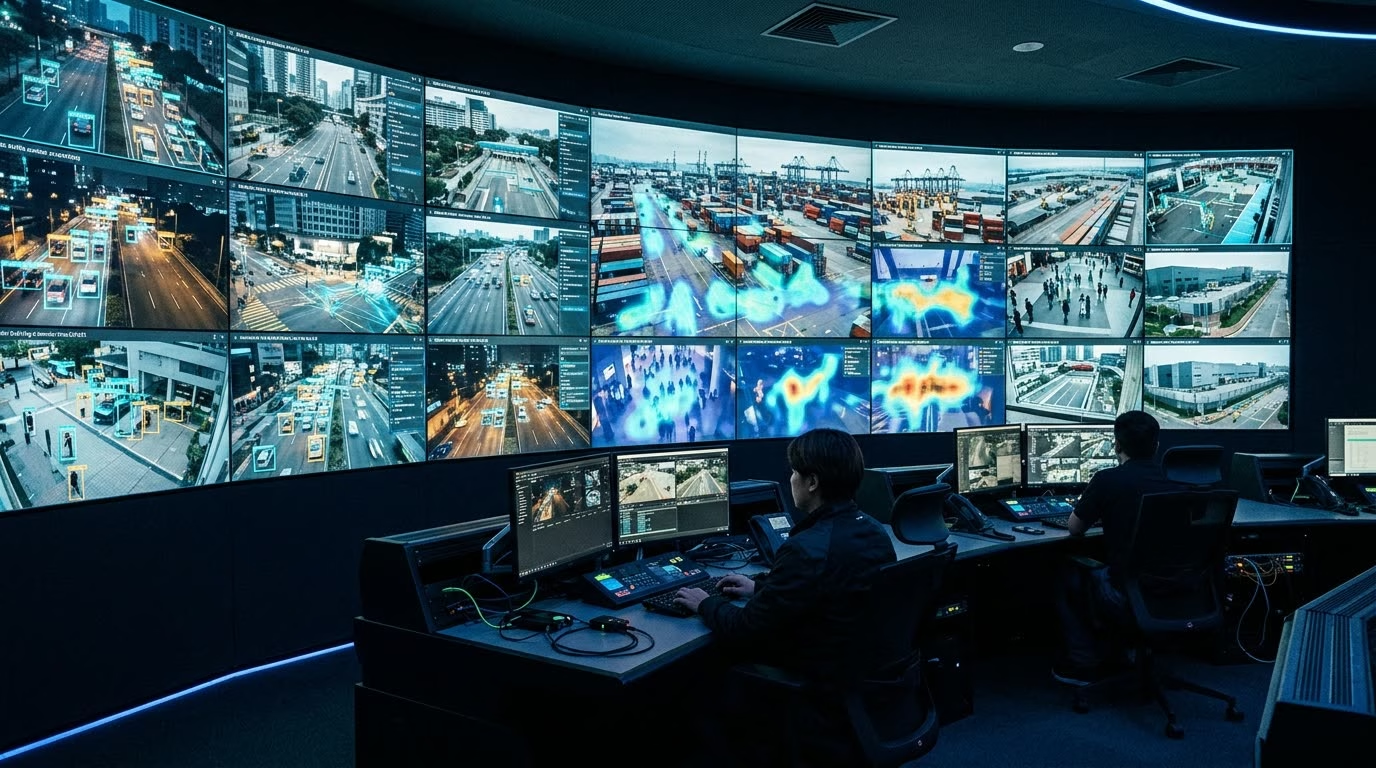
Modern systems use artificial intelligence for video surveillance to solve this problem. Deep learning models run directly on camera streams to detect, track, and classify objects in real time. Instead of reacting to changed pixels, these models identify actual humans, vehicles, and specific behaviors.
Today, engineers face critical architecture choices. Streaming dozens of high-resolution feeds to cloud servers creates steep bandwidth costs and latency delays. As a result, teams are shifting inference workloads to compact edge hardware located right beside the cameras.
Table of Contents
- The Failure of Legacy Motion Detection
- Core Computer Vision Architectures for Surveillance
- Edge Hardware vs. Cloud Streaming: Bandwidth and Latency Math
- Building a Production Pipeline
- Architecture Comparison Factsheet
- Privacy Protection and Regulatory Compliance
- Related Technical Developments
- Frequently Asked Questions
The Failure of Legacy Motion Detection
Early digital video recorders used basic frame differencing. When a preset percentage of pixels changed color or brightness between video frames, the system triggered an alert.
In practical use, this method creates constant noise. A tree branch swaying in the wind changes thousands of pixels. Car headlights sweeping across a parking lot trigger multiple cameras at once. Spiders spinning webs over camera lenses create continuous motion events.
Security control rooms quickly run into alert fatigue. When 90 percent of incoming notifications are false alarms, human operators tune out. Guards lower sensor sensitivity, silence audio alerts, or ignore notifications altogether. When an actual intrusion happens, nobody notices in time.
Artificial intelligence replaces basic pixel counting with semantic object detection. Neural networks scan the video frame to locate distinct objects. The software generates bounding boxes around people, cars, trucks, and bicycles. If wind blows through tree branches, pixel values change, but the network detects no target objects. The system ignores the movement and stays quiet.
Core Computer Vision Architectures for Surveillance
Modern video analytics pipelines rely on a multi-stage software stack. Raw video frames pass through decoding, object detection, multi-object tracking, and behavioral logic.
1. Real-Time Object Detectors
Surveillance demands models that process frames at 15 to 30 frames per second with minimal latency. Two primary model families dominate current installations:
- Single-Stage Convolutional Detectors (YOLO Series). Models like YOLOv10 and YOLOv11 process an entire image in a single forward pass. They balance small memory footprints with high mean average precision (mAP). They reliably locate targets even in poor lighting or heavy rain.
- Real-Time Detection Transformers (RT-DETR). Vision transformers remove the need for non-maximum suppression (NMS). This structural change ensures predictable, steady inference latency under dense scene conditions.
2. Multi-Object Tracking (MOT)
Detecting an object in one frame is not enough. A surveillance platform must understand that a person detected in frame 10 is the same person in frame 100.
Tracking algorithms like ByteTrack and BoT-SORT combine spatial Kalman filters with appearance embeddings:
- Kalman Filtering. Predicts the future position of a bounding box based on its past velocity and heading.
- Bipartite Matching. Uses the Hungarian algorithm to match newly detected boxes against existing tracked paths.
- Re-Identification (Re-ID). Extracts lightweight vector embeddings to re-identify an individual who steps behind a pillar and reappears seconds later.
3. Spatial and Behavioral Rules
Once the system tracks objects as stable paths, software rules trigger contextual events:
- Virtual Tripwires. Draws vector lines across gates or perimeter fences. The system triggers an alert only when a person or vehicle crosses the line in a forbidden direction.
- Loitering and Dwell Timers. Tracks how long a person remains inside a sensitive geometric zone. If a person stands near an emergency exit or ATM for more than three minutes, the system notifies security staff.
- Object Left Behind. Flags luggage, boxes, or backpacks that remain still after the owner walks away.
- Optical Flow Velocity. Measures how fast an object moves across calibrated physical distances to detect speeding vehicles or fleeing suspects.
Edge Hardware vs. Cloud Streaming: Bandwidth and Latency Math
Choosing where to run computer vision models shapes system cost and operational reliability.
The Cloud Streaming Trap
Many SaaS vendors urge customers to stream all security cameras directly to cloud servers. For small shops with two cameras, this approach works fine. In enterprise settings, the physics of network bandwidth quickly breaks down.
Consider a site with 20 security cameras:
- Each 4K camera delivers video at 3840 by 2160 pixels at 20 frames per second.
- Using standard H.264 compression at acceptable quality, each camera needs roughly 8 Megabits per second (Mbps).
- Twenty cameras produce 160 Mbps of continuous, non-stop upload traffic.
- That equals 52 Terabytes of video data pushed across the local internet link every single month.
Most business internet connections cannot sustain 160 Mbps of dedicated upstream bandwidth without packet loss. On top of that, cloud providers charge recurring fees for inbound streaming, GPU compute time, and video storage.
If the external internet connection drops during a storm or network cut, cloud-based cameras stop detecting threats entirely.
The Local Edge Solution
Edge computing flips this workflow. Instead of sending raw video streams across the internet, an on-site server or smart camera processes video locally.
Engineers deploy compact hardware accelerators:
- NVIDIA Jetson Series (Orin Nano and Orin NX). Delivers between 40 and 100 TOPS of AI compute at under 25 watts of power. A single Jetson unit handles 8 to 16 RTSP streams in real time.
- Hailo-8 M.2 Acceleration Modules. Offers 26 TOPS of efficient vision processing. Fits neatly into existing x86 network video recorders via standard PCIe slots.
- Intel NUC Systems with OpenVINO. Leverages integrated Intel GPUs and Neural Processing Units (NPUs) to decode and score video feeds affordably.
The edge device connects directly to cameras via local Gigabit Ethernet. Inference happens locally with latency below 30 milliseconds.
The system sends only tiny JSON event packets to the cloud. Each packet contains the object label, bounding box coordinates, and a timestamp. When an incident occurs, the unit uploads a 5-second video clip. This reduces external network bandwidth consumption by over 95 percent.
Building a Production Pipeline
Running video AI in production requires a lean software architecture. The pipeline converts high-bandwidth video into actionable data:
- RTSP Stream Ingestion. The system pulls RTSP or ONVIF video feeds from local IP cameras over RTSP using GStreamer or FFmpeg.
- Hardware Decoding. Dedicated silicon (such as NVIDIA NVDEC or Intel Quick Sync) decodes compressed H.264 and H.265 streams directly into GPU memory buffers.
- Model Quantization. Floating point 32 models are quantized to FP16 or INT8 using TensorRT or OpenVINO. This cuts memory usage in half and doubles inference speed with minimal loss in accuracy.
- Tracking and Event Generation. Fast CPU or GPU threads run ByteTrack to assign IDs and test bounding boxes against virtual zone rules.
- Storage and VMS Dispatch. Events trigger recordings in Video Management Software (VMS) like Milestone, Network Optix, or open-source solutions like Frigate NVR.
Architecture Comparison Factsheet
The table below contrasts the four main architectural methods used for video surveillance today.
| Architecture Type | Detection Latency | Upload Bandwidth Needed | Hardware Investment | False Alarm Rate | Data Privacy Exposure |
|---|---|---|---|---|---|
| Legacy Pixel Differencing | Under 10 ms | Zero (Local Storage) | Low (Basic NVR) | High (70% to 95%) | Low (Kept on Premises) |
| Cloud-Only Vision SaaS | 500 ms to 3 seconds | Very High (8 Mbps per 4K feed) | Low (Dumb Cameras) | Low (Under 5%) | High (Constant WAN Streams) |
| Edge Appliance (Local AI NVR) | Under 30 ms | Extremely Low (JSON alerts only) | Moderate (Edge AI Boxes) | Low (Under 5%) | Low (Video Retained Locally) |
| Hybrid Enterprise Vision | Under 30 ms | Low (Metadata + Clips) | Moderate to High (Scalable) | Very Low (Under 2%) | Low (On-Chip Anonymization) |
Privacy Protection and Regulatory Compliance
Deploying artificial intelligence for video surveillance brings legal responsibilities. Governments worldwide are enforcing strict rules on public visual data collection.
Biometric Identification vs. Object Detection
Engineers must separate general object detection from biometric identification:
- Object Detection (Low Risk). Classifies an object as a “person” or “vehicle.” The system notes presence and movement without identifying who the person is.
- Biometric Recognition (High Risk). Compares facial vectors or walking gait against stored databases to identify specific individuals.
Biometric tracking faces tough restrictions. The European Union AI Act strictly regulates remote biometric identification in public spaces. In the United States, regulations like the Illinois Biometric Information Privacy Act (BIPA) enforce severe financial penalties for unauthorized facial capture.
Privacy by Design at the Edge
Modern engineering teams use edge computing to protect citizen privacy:
- Automated Face and Plate Redaction. Edge processors run lightweight secondary models that blur human faces and vehicle license plates before writing frames to disk.
- Role-Based Forensic Access. Raw, unmasked video remains locked behind dual-custody cryptographic keys. Only authorized personnel can unmask footage during verified police or safety reviews.
- Data Minimization. Instead of recording continuous footage, systems store structured text logs of events. Video clips delete automatically after 14 to 30 days unless flagged for review.
Related Technical Developments
Related Infrastructure & AI Governance Analysis
- Learn how Watchtower Labs secures defense perimeters using autonomous sensor fusion and computer vision.
- Review how state agencies deploy algorithmic risk scoring and the oversight challenges involved.
- Follow how lawmakers evaluate AI infrastructure risks in state legislative hearings.
Frequently Asked Questions
How does artificial intelligence for video surveillance reduce false alarms?
Legacy systems trigger alerts whenever pixels change color or brightness, causing false alarms from weather, shadows, and headlights. AI systems use trained deep neural networks to recognize actual objects like people and vehicles. If movement does not match a verified target, the system ignores it.
What is the difference between edge AI and cloud AI in video surveillance?
Cloud AI systems upload full video streams across the internet to process frames in remote data centers. Edge AI processes video streams locally on compact hardware accelerators near the cameras. Edge AI provides faster response times, keeps video data on premises, and cuts internet bandwidth consumption by over 95 percent.
Can AI video surveillance operate without capturing personal biometric data?
Yes. Standard computer vision models detect general object classes like people, cars, or boxes without identifying who anyone is. In addition, edge processors can automatically blur faces and vehicle plates in real time before saving footage or sending alerts.
What hardware is required to run local AI video surveillance?
Small installations can use an NVIDIA Jetson Orin Nano, a Hailo-8 M.2 accelerator, or an Intel system with OpenVINO. These low-power devices handle multiple RTSP video feeds in real time using quantized INT8 or FP16 models.
🚀 Building High-Throughput Edge AI or Custom Computer Vision Pipelines?
TeckScaler designs and delivers specialized edge inference engines, distributed media servers, and production machine learning pipelines. Consult with our systems architecture team →








[…] protection and edge vision hardware beyond defense logistics, read our technical breakdown of artificial intelligence for video surveillance to evaluate edge inference models, NVR hardware pipelines, and network bandwidth […]