
Huawei founder and chief executive Ren Zhengfei told The New York Times that United States trade sanctions forced his company and China to achieve semiconductor self-reliance, according to The Next Web.
Speaking from Huawei’s Shenzhen campus in an interview published on November 26, 2026, the 82-year-old executive asked reporters to pass thanks to President Donald Trump and share the story of the headquarters’ gilded ‘Trump Corridor.’
Executive Summary
- Sardonic Remarks: Huawei founder Ren Zhengfei told The New York Times to thank President Donald Trump for export curbs that forced China into domestic semiconductor independence.
- Legal & Sanction Context: The interview ran two days after a New York federal jury convicted Huawei of trade secret theft conspiracy and Iran-linked bank fraud, verdicts Huawei disputes.
- R&D Spending & DeepSeek: Huawei invests over $27 billion annually in R&D and collaborates with Chinese AI labs like DeepSeek to run models on Ascend clusters.
- Compute Gap Persists: Research firm Epoch AI estimates Huawei will produce under 4% of Nvidia’s AI computing capacity this year, with Ascend 950 at half H100 speed.
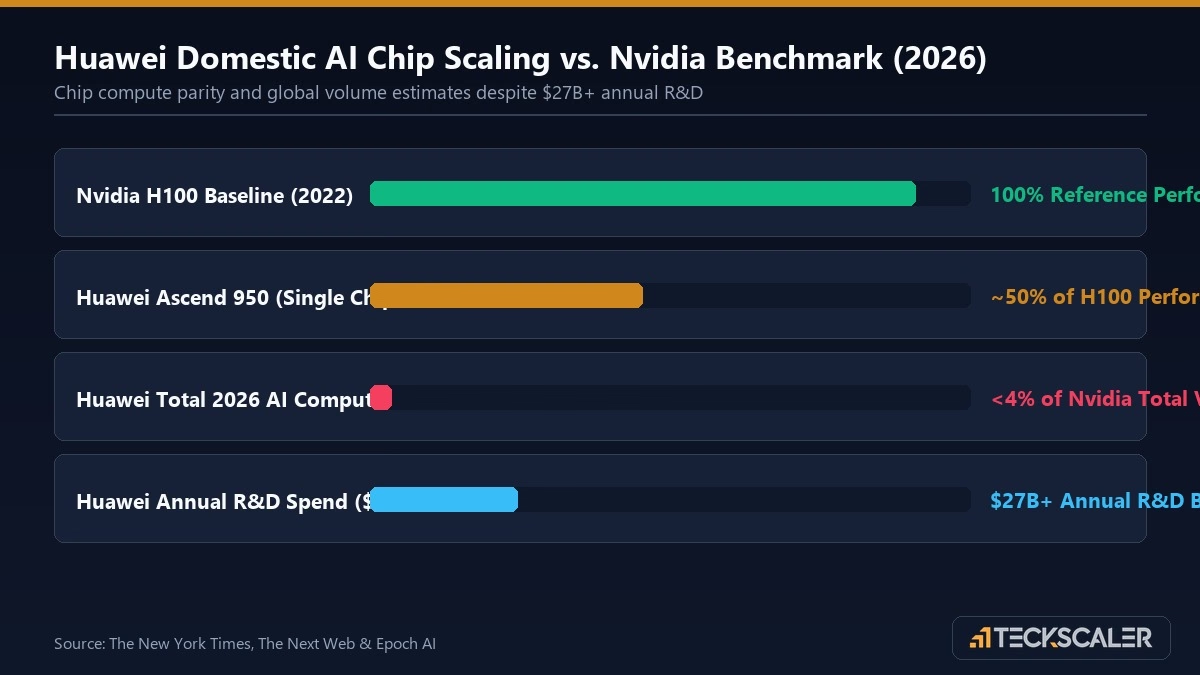
Huawei Ascend Ecosystem vs. Nvidia Benchmark Estimates
| Dimension | Huawei Domestic Position | Nvidia / Western Benchmark | Source / Authority |
|---|---|---|---|
| Annual R&D Investment | Over $27 billion per year | Multi-billion global silicon budget | The New York Times |
| Flagship Accelerator | Ascend 950 (~50% of H100 compute) | Nvidia H100 (2022) & Blackwell/Rubin | Epoch AI / NYT |
| Total 2026 Compute Volume | Under 4% of Nvidia’s AI compute output | Dominant global hyperscale supply | Epoch AI Estimate |
| Lithography Access | Blocked from advanced ASML EUV tools | Full TSMC leading-edge node access | NYT / TNW |
New York jury verdict and tightened US export curbs
The interview appeared two days after a federal jury in New York found Huawei guilty of conspiring to steal U.S. trade secrets and committing bank fraud tied to Iran, charges Huawei labeled meritless.
Publication also followed Washington’s November 16 crackdown barring Chinese access to U.S. AI chips through offshore data centers.
Former National Security Council official Liza Tobin told the Times that officials in Trump’s first term believed initial sanctions might deliver a death blow to Huawei.
DeepSeek partnerships and cluster-level scaling
Huawei spends more than $27 billion every year on research and development and works closely with Chinese AI labs such as DeepSeek to tune software for Ascend processors.
Because single domestic chips lag top Western hardware, Huawei links large clusters of Ascend accelerators together to compete on aggregate system throughput.
Ren said China has built a complete survival supply chain and argued it is only a matter of time before domestic chips catch up.
Epoch AI estimates show wide performance gap
Despite $27 billion in annual research spending and internal memory efforts, research group Epoch AI projects Huawei will fabricate under 4 percent of Nvidia’s AI computing capacity this year.
Huawei’s strongest chip, the Ascend 950, delivers roughly half the compute speed of Nvidia’s 2022-era H100 processor. China also remains cut off from ASML’s advanced lithography tools.
Frequently Asked Questions
Why did Huawei’s founder mention Donald Trump in his NYT interview?
Ren Zhengfei jokingly asked reporters to thank Donald Trump because first-term U.S. chip sanctions pushed Huawei to build its own domestic supply chain and Ascend processors.
How does Huawei’s Ascend 950 compare to Nvidia GPUs?
According to Epoch AI estimates cited by The New York Times, Huawei’s Ascend 950 offers roughly half the performance of Nvidia’s 2022 H100 chip, and Huawei makes under 4% of Nvidia’s total AI compute.
What legal verdict did Huawei face right before the interview ran?
Two days before publication, a New York federal jury convicted Huawei of trade secret theft conspiracy and Iran-linked bank fraud, which Huawei called factually meritless.
Related Analysis & Guides
- Nvidia halts AI GPU shipments to Southeast Asia data centers
- US-China AI Cold War Shifts to Compute Diplomacy
Primary Sources & References
Published by the TeckScaler Editorial Team.