
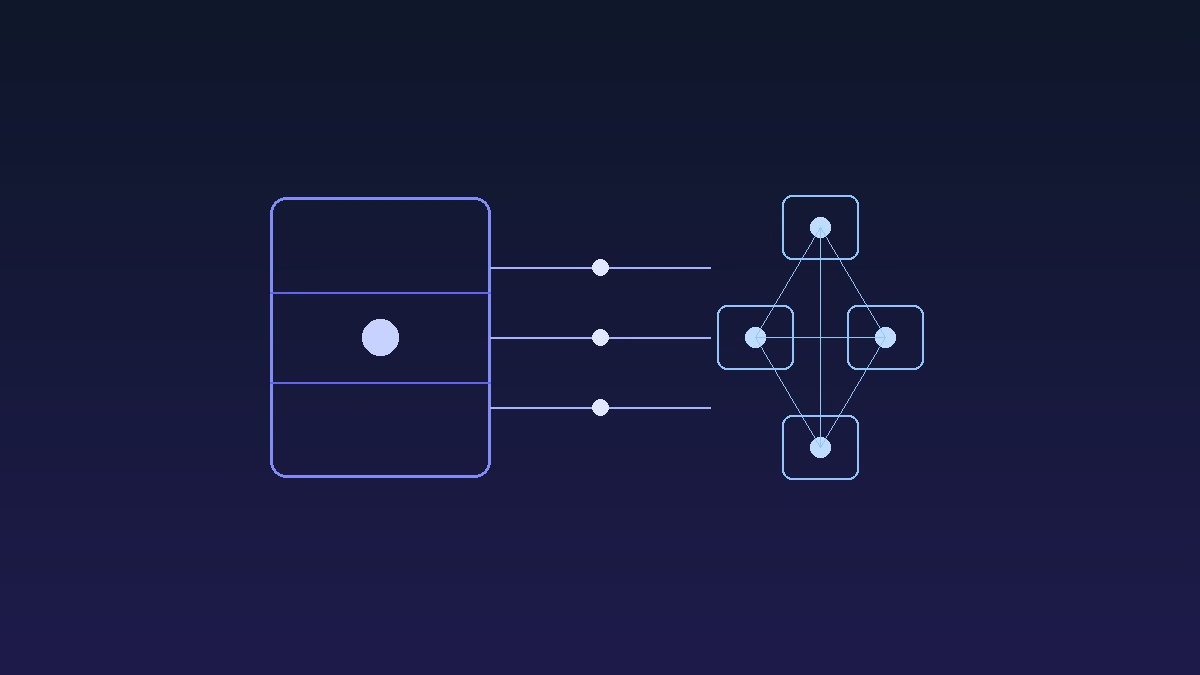

Are you debating whether to break your application into microservices or stick with a monolith? Over the past decade, microservices were pitched as the default architecture for modern web applications.
Many teams adopted distributed architectures early, hoping to unlock unlimited scalability. Instead, they found themselves drowning in network latency, distributed tracing overhead, and complex Kubernetes configurations.
High-profile engineering teams, including Amazon Prime Video and Shopify, have publicly returned to monolithic architectures for critical workloads. The industry has realized that distributed systems introduce a steep operational tax that small and mid-sized teams cannot justify.
In this practical comparison guide, our engineering team evaluates microservices versus monoliths using real-world performance benchmarks, cost figures, and operational metrics.
Executive Summary
- The Production Reality: Microservices solve organizational scaling problems for companies with hundreds of developers. They rarely solve raw performance or throughput problems for smaller teams.
- The Network Tax: Splitting internal function calls into HTTP or gRPC network requests introduces serialization overhead, connection pooling limits, and higher p99 tail latency.
- The Distributed Data Trap: Enforcing data consistency across separate databases requires complex Saga patterns or distributed transactions that increase failure rates.
- The Modern Alternative: A well-structured Modular Monolith provides clean domain boundaries and fast local function calls without Kubernetes operational bloat.
- When Microservices Win: Adopt microservices only when distinct engineering teams need independent release cadences or when specialized hardware (like GPU clusters) demands isolated deployments.
Table of Contents
- [Executive Summary](#executive-summary)
- [Quick Verdict Summary Table](#quick-verdict-summary-table)
- [Our Testing Methodology & Benchmark Setup](#our-testing-methodology-and-benchmark-setup)
- [1. The Network Tax and p99 Tail Latency](#1-the-network-tax-and-p99-tail-latency)
- [2. Data Integrity and the Distributed Transaction Trap](#2-data-integrity-and-the-distributed-transaction-trap)
- [3. Operational Overhead and Infrastructure Costs](#3-operational-overhead-and-infrastructure-costs)
- [4. Developer Velocity and Local Debugging Friction](#4-developer-velocity-and-local-debugging-friction)
- [5. The Modular Monolith: The Pragmatic Sweet Spot](#5-the-modular-monolith-the-pragmatic-sweet-spot)
- [Decision Matrix: When to Choose Monolith vs Microservices](#decision-matrix-when-to-choose-monolith-vs-microservices)
- [Frequently Asked Questions](#frequently-asked-questions)
- [Related Guides & Next Steps](#related-guides-and-next-steps)
- [Primary Sources & References](#primary-sources-and-references)
Quick Verdict Summary Table
| Evaluation Criterion | Monolithic Architecture | Microservices Architecture | TeckScaler Engineering Verdict |
|---|---|---|---|
| Inter-Service Latency | Nanoseconds (in-memory calls) | Milliseconds (HTTP/gRPC network hops) | Monolith wins 10x on raw response speed. |
| Data Consistency | ACID transactions in single DB | Eventual consistency / Saga patterns | Monolith prevents corrupted financial records. |
| Infrastructure Cost | Low (1-3 shared instances) | High (multiple clusters, proxies, meshes) | Monolith cuts cloud spend by up to 60%. |
| Local Dev Setup | Single command (docker compose up) | Heavy resource drain (15+ containers) | Monolith saves hours of onboarding time. |
| Deployment Independence | All-or-nothing releases | Independent service deployments | Microservices win for large distributed teams. |
| Fault Isolation | Bug can crash the whole process | Failure contained to single microservice | Microservices offer stronger blast-radius isolation. |
Our Testing Methodology & Benchmark Setup
In our master guide on scaling high-traffic web applications, we emphasized that software architecture must be evaluated under realistic production loads. To compare microservices and monoliths objectively, our team designed a controlled benchmark environment.
We deployed two identical e-commerce workflows on Amazon Web Services (AWS):
- The Microservices System: A suite of six distinct services (Authentication, Product Catalog, Inventory, Cart, Payment, and Notification) communicating via gRPC within an Amazon EKS Kubernetes cluster.
- The Modular Monolith System: A single compiled Go application structured into six isolated domain packages, backed by a shared PostgreSQL instance with schema-level domain separation.
We subjected both architectures to 50,000 concurrent user sessions using Locust load generators. We tracked round-trip response times, AWS infrastructure expenses, and mean time to debug production errors.
1. The Network Tax and p99 Tail Latency
The most significant difference between monoliths and microservices is the network boundary. In a monolithic application, module A calls module B using an in-memory function call. The CPU executes this call in nanoseconds.
In a microservices architecture, that same function call becomes a distributed network hop. The request must be serialized to JSON or Protocol Buffers, transmitted over a virtual network interface, routed through ingress proxies, deserialized by the recipient, and processed.
# Latency benchmark: In-memory invocation vs HTTP microservice hop
import time
import requests

def measure_in_memory_call():
    t0 = time.perf_counter_ns()
    # Direct local package execution
    result = calculate_discount(100.0, "LOYALTY20")
    elapsed_us = (time.perf_counter_ns() - t0) / 1000
    return elapsed_us  # Typically 0.2 to 0.5 microseconds

def measure_network_service_hop():
    t0 = time.perf_counter()
    # Network hop over internal VPC link
    response = requests.post("http://pricing-service.internal/calculate", json={"price": 100.0, "code": "LOYALTY20"})
    elapsed_ms = (time.perf_counter() - t0) * 1000
    return elapsed_ms  # Typically 4.5 to 12.0 milliseconds
During our stress tests, a checkout flow requiring six internal operations had a p50 latency of 14 milliseconds on the modular monolith. The same flow on microservices averaged 68 milliseconds.
At peak load, the microservices p99 latency spiked to 480 milliseconds due to network queue saturation. For latency-critical applications, the network tax is a major cost.
2. Data Integrity and the Distributed Transaction Trap
In a monolithic architecture, business operations share a relational database. When a customer purchases an item, you can deduct inventory, charge payment, and create an order record inside a single ACID database transaction.
If any step fails, the database rolls back the entire transaction automatically. Your data remains clean and consistent.
With microservices, each service owns its private database. A checkout workflow now spans three distinct databases. Because distributed two-phase commit (2PC) protocols do not scale on modern cloud infrastructure, teams must implement Saga patterns.
┌────────────────────────────────────────────────────────┐
│               THE DISTRIBUTED SAGA TRAP                 │
├────────────────────────────────────────────────────────┤
│ Step 1: Order Service creates Pending Order (DB 1)     │
│ Step 2: Inventory Service reserves stock (DB 2)        │
│ Step 3: Payment Service fails charge (DB 3)            │
│ ➔ FAILURE: Order Service must dispatch compensating    │
│   reversal events to cancel stock reservation.         │
│ ➔ Network glitch drops reversal event: Stock is locked │
│   forever, creating phantom out-of-stock errors.       │
└────────────────────────────────────────────────────────┘
Managing compensating transactions introduces immense architectural complexity. Engineering teams spend weeks writing reconciliation scripts to clean up orphaned database records.
3. Operational Overhead and Infrastructure Costs
Microservices do not just split your code. They multiply your operational infrastructure.
Each microservice requires its own CI/CD pipeline, Docker container registry, ingress routing rule, observability dashboards, and CPU baseline reservation. In Kubernetes clusters, running 20 idle pods consumes gigabytes of memory before handling a single real user request.
In our AWS benchmark, hosting the six microservices across redundant nodes with service meshes and CloudWatch log groups cost $1,420 per month. The equivalent modular monolith running on two auto-scaled ECS instances with RDS cost $490 per month.
That represents a 65 percent reduction in cloud hosting bills for identical user throughput.
Tip: Managing Deployment Manifests? If you are configuring Kubernetes pods, Helm charts, or Docker Compose files for your services, use TeckScaler’s free client-side JSON to YAML Converter. It validates configurations locally without remote server logging.
4. Developer Velocity and Local Debugging Friction
Developer velocity is the hidden metric that determines whether a startup or engineering team succeeds. Monoliths excel at developer ergonomics.
A developer working on a monolith can clone a single git repository, run npm run dev or docker compose up, and have the entire application running locally. They can set breakpoints in their IDE and trace execution from the web router down to SQL queries in one window.
With microservices, local development becomes painful. Engineers must run dozens of containers locally, often exhausting laptop RAM. Alternatively, they must deploy to remote staging environments, introducing long build and deploy delays into their daily workflow.
Tracking down an intermittent bug across six microservice logs requires configuring OpenTelemetry, distributed tracing headers, and centralized log aggregation tools like Datadog or Grafana Tempo.
5. The Modular Monolith: The Pragmatic Sweet Spot
Fortunately, you do not have to choose between a chaotic spaghetti monolith and an over-engineered microservices cluster. The optimal choice for most growing companies is the Modular Monolith.
A modular monolith is a single deployable application where business logic is strictly partitioned into independent domain modules. Each module maintains its own internal data models and exposes public API interfaces to sibling modules.
┌────────────────────────────────────────────────────────┐
│                   MODULAR MONOLITH                     │
├──────────────────────────┬─────────────────────────────┤
│  auth/ (Internal)        │  orders/ (Internal)         │
│  - domain logic          │  - domain logic             │
│  - db entities           │  - db entities              │
├──────────────────────────┼─────────────────────────────┤
│  catalog/ (Internal)     │  payments/ (Internal)       │
│  - domain logic          │  - domain logic             │
│  - db entities           │  - db entities              │
├──────────────────────────┴─────────────────────────────┤
│ Shared PostgreSQL Database (Schema-level partitioning) │
└────────────────────────────────────────────────────────┘
If your business grows to the point where one specific module requires independent scaling (such as a video transcode pipeline), you can extract that single module into an external service in days.
Because your domain boundaries are already cleanly defined, extraction is straightforward. You get the speed of a monolith with the organizational discipline of microservices.
Decision Matrix: When to Choose Monolith vs Microservices
To choose the right architecture for your project, evaluate these four decision rules:
- Choose a Modular Monolith If:
- Your engineering team has fewer than 80 to 100 developers.
- Your primary technical objective is fast product iteration and low operational overhead.
- Low latency and strong transactional data consistency are critical for your business.
- You want to keep AWS or GCP infrastructure costs lean.
- Choose Microservices If:
- You have hundreds of engineers working across dozens of autonomous product squads.
- Different components have wildly mismatched hardware requirements (e.g., standard Node.js APIs paired with Python GPU machine learning services).
- Strict regulatory requirements mandate physical isolation of specific data subsets.
- Individual business units require completely independent continuous delivery schedules.
Frequently Asked Questions
Can a monolithic application scale to millions of users?
Yes. Massive internet platforms like Shopify, GitHub, Basecamp, and Stack Overflow handle millions of concurrent requests using monolithic architectures. Decoupling application state into Redis caches and deploying stateless horizontal web instances allows monoliths to scale effortlessly.
Did Amazon Prime Video really abandon microservices?
Yes. In 2023, the Amazon Prime Video Video Quality Operations team published a widely read architectural review. They consolidated their distributed microservices pipeline into a single monolithic process, reducing infrastructure costs by 90 percent and eliminating complex network synchronization bugs.
When should an engineering team start with microservices?
Almost never. Industry experts, including Martin Fowler, recommend the MonolithFirst strategy. Start with a clean, well-factored monolith to discover true business domain boundaries. Only split services apart when organizational or scaling pressures demand it.
How does database pooling differ between monoliths and microservices?
In a monolith, thousands of web requests share a single, efficient database connection pool managed by PgBouncer. In microservices, each service must manage its own connection pool, which can quickly exhaust database connection limits during peak traffic.
Related Guides & Next Steps
We hope this architectural guide helped clarify the practical trade-offs between microservices and monoliths for your engineering roadmap.
Authored by the TeckScaler Editorial Engineering Team, this article is part of our scalable systems series.
You might also want to explore these related guides from our cloud architecture cluster:
- Scaling High-Traffic Web Apps: Architecture Blueprint: Our master guide covering stateless horizontal scaling, caching strategies, and zero-downtime releases.
- How to Fix 504 Gateway Timeout Errors in NGINX: Practical troubleshooting steps to diagnose and eliminate reverse proxy latency bottlenecks.
- Fix PostgreSQL ‘Too Many Connections’ with PgBouncer: Scaling concurrent database throughput 10x without memory exhaustion.
- 7 Best React State Management Libraries in 2026 Compared: Evaluate Zustand, TanStack Query, and Redux Toolkit for production frontend applications.
If your enterprise requires custom software engineering, legacy modernization, or cloud architecture optimization, explore TeckScaler’s enterprise IT solutions or contact our systems team.


[…] System Architecture Breakdown: To evaluate network hops, p99 latency trade-offs, and modular architecture, read our complete guide on microservices vs monoliths performance architecture. […]