
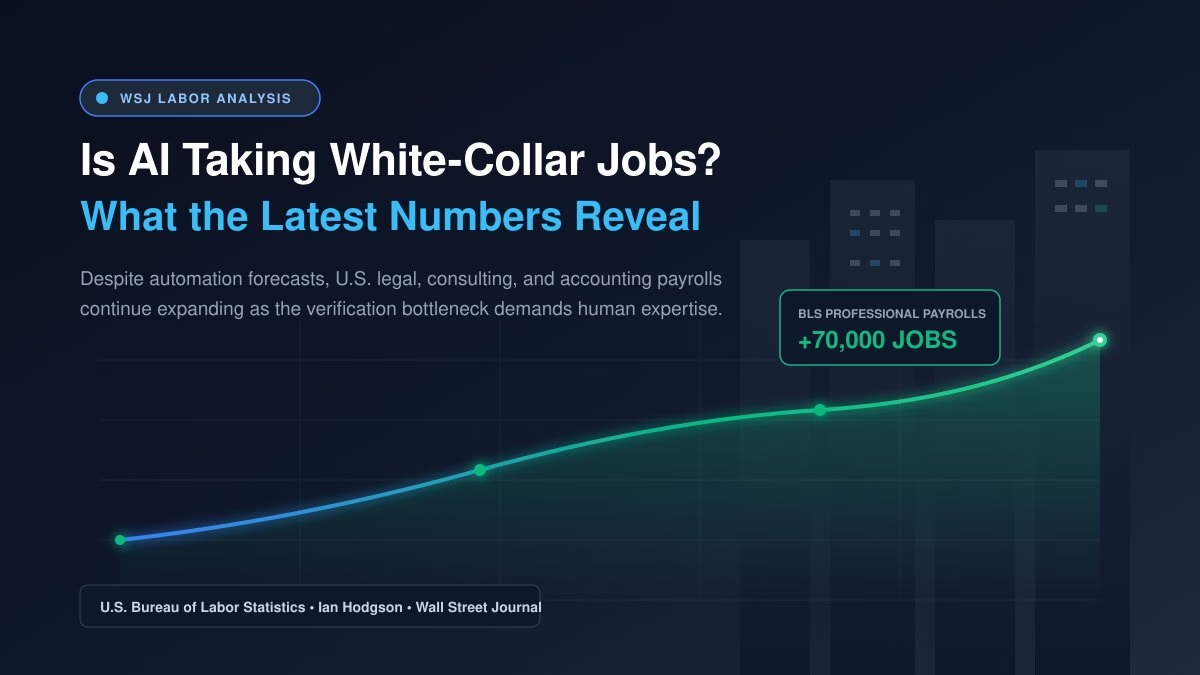

For two years, corporate executives and artificial intelligence evangelists warned that generative algorithms would trigger an unprecedented white-collar labor collapse, displacing millions of knowledge workers across corporate America. However, recent economic data compiled by the Wall Street Journal and published by the U.S. Bureau of Labor Statistics (BLS) paints a starkly different reality: professional and business services payrolls continue to expand, debunking predictions of widespread automated job destruction.
Executive Summary
- Empirical Payroll Growth: Despite widespread corporate adoption of machine learning tools, U.S. professional and business services added over 70,000 net positions over the past quarter, holding national unemployment steady at 4.1 percent.
- High-Exposure Stability: Sectors identified as most vulnerable to generative automation, including legal advisory, corporate accounting, and management consulting, recorded positive job creation and sustained wage gains.
- The Verification Bottleneck: Algorithmic hallucinations, legal liability, and compliance mandates force organizations to maintain human experts who review, edit, and validate every automated work product.
- Jevons Paradox in Corporate Knowledge: Reducing the marginal cost and time required to draft briefs, analyze datasets, and generate code has dramatically increased corporate demand for comprehensive reporting and strategic filings.
- The Junior Analyst Squeeze: While net aggregate employment remains positive, entry-level recruitment faces selective friction as senior practitioners leverage AI tools to handle initial research and draft composition.
Macroeconomic Data vs the Apocalypse Narrative
When OpenAI launched ChatGPT and subsequent autonomous agent frameworks, tech consultancies published alarming forecasts predicting that up to 300 million knowledge-work jobs would be eliminated or degraded within half a decade. Two years into enterprise deployment, those dire forecasts remain unreflected in official labor statistics.
The U.S. Bureau of Labor Statistics Employment Situation Report confirms that aggregate professional employment remains robust. Rather than shedding positions, corporate employers in finance, computer systems design, and legal services continue to post healthy net additions. The national unemployment rate hovers near historical lows at 4.1 percent, with prime-age labor force participation sustaining levels not seen since the late 1990s.
Labor economists investigating the disconnect between executive commentary and statistical hiring data note that corporate restructuring announcements often cite artificial intelligence as a convenient cover for standard cost cutting, post-pandemic over-hiring corrections, or shifting interest rate environments. In operational practice, companies rarely fire entire teams when deploying new software; instead, they reassign workers to handle higher-order analytical workloads.
Why High-Exposure Sectors Continue to Hire
Academic researchers identified legal practice, tax advisory, and accounting as the corporate sectors with the highest theoretical exposure to generative text models. However, these specific industries have demonstrated remarkable employment resilience over the past twelve months.
In legal services, law firms have widely adopted specialized AI assistants to summarize discovery documents, parse lengthy contracts, and format jurisdictional citations. Yet partner-track hiring and legal associate positions have held firm. Corporate litigation volume and regulatory compliance demands have expanded in tandem with technological complexity. Organizations facing antitrust scrutiny, consumer privacy investigations, and intellectual property litigation require more human litigators, not fewer.
Similarly, in corporate accounting and auditing, certified public accountants (CPAs) face strict statutory liability under federal securities regulations. An automated language model cannot sign an independent audit opinion or certify Sarbanes-Oxley internal financial controls. As a result, accounting firms use machine learning to accelerate preliminary ledger reconciliation while redirecting staff accountants toward forensic investigations and strategic tax advisory.
The Verification Bottleneck: Liability and Hallucination Risks
A primary mechanical reason generative models have not replaced human white-collar professionals is what organizational researchers term the verification bottleneck. Because large language models operate on probabilistic pattern matching rather than deterministic factual recall, they periodically invent citations, misinterpret contractual nuances, and generate flawed numerical calculations.
In high-stakes corporate environments, the cost of an undetected hallucination can be catastrophic. A fabricated case citation in a federal court filing can result in judicial sanctions and professional disbarment. A miscalculated revenue recognition formula in an SEC filing can trigger regulatory investigations and shareholder lawsuits. Consequently, every output generated by an algorithmic system requires meticulous review by experienced human analysts.
When senior professionals must spend considerable cognitive effort verifying every footnote, equation, and legal clause produced by an AI tool, the net labor-saving dividend narrows considerably. The human remains the legally accountable node in the workflow, anchoring organizational headcounts.
Jevons Paradox: How Cheaper Analysis Multiplies Demand
The resilience of white-collar employment is also an empirical manifestation of Jevons Paradox. Formulated in the nineteenth century by economist William Stanley Jevons, the principle states that improving the efficiency with which a resource is used often leads to an increase, rather than a decrease, in overall consumption of that resource.
In knowledge work, the resource is analytical synthesis. When drafting a 50-page competitive intelligence dossier or writing custom automated integration scripts previously required three weeks of human labor, corporations conducted such deep analyses infrequently, reserving them for major strategic milestones.
When artificial intelligence reduces the baseline time to assemble an initial briefing to thirty minutes, corporate leadership does not eliminate the strategic planning department. Instead, they demand ten times as many briefings. Executives now commission daily scenario analyses, weekly regulatory assessments, and continuous competitive tracking. Cheaper analysis creates an insatiable corporate appetite for strategic insight, expanding the scope of responsibilities for knowledge workers.
The Junior Hiring Squeeze: Career Ladder Restructuring
While aggregate macroeconomic data shows net job growth, the distribution of that hiring across career stages is experiencing real operational friction. Senior practitioners equipped with automated tools are increasingly able to complete first-pass research, document formatting, and basic boilerplate composition without delegating to junior associates.
This dynamic has produced what industry recruiters describe as the junior hiring squeeze. Entry-level software developers, junior financial analysts, and first-year legal associates face longer search durations and higher technical interview standards. Employers increasingly expect new graduates to possess practical prompt architecture, model fine-tuning skills, and systems evaluation capabilities from day one.
This organizational shift creates a structural apprenticeship challenge. If corporations reduce entry-level positions because AI handles junior tasks, how will organizations train the next generation of senior partners, lead software architects, and audit principals? Industry leaders are beginning to redesign training programs to ensure early-career staff develop critical verification instincts rather than relying blindly on automated outputs.
Technical Factsheet: White-Collar Employment Metrics by Industry
The table below highlights recent employment dynamics, AI exposure levels, and structural hiring factors across major U.S. knowledge-work categories based on federal labor statistics and industry surveys.
| Industry & Sector | AI Exposure Index | Trailing 12-Month Job Trend | Primary Limiting Constraint |
|---|---|---|---|
| Legal Services & Advisory | High (Document discovery, briefs) | +2.4% Net Payroll Growth | Bar licensing, malpractice liability, court sanctions |
| Accounting, Tax & Audit | High (Ledger reconciliation, tax code) | +1.8% Net Payroll Growth | Statutory audit mandates, Sarbanes-Oxley signoffs |
| Management & Tech Consulting | Moderate (Slide decks, research) | +3.1% Net Payroll Growth | Client trust, change management, executive advisory |
| Computer Systems & Software | High (Code generation, testing) | +1.2% Net Payroll Growth | Systems architecture, security audits, verification |
| Corporate Marketing & PR | High (Draft copywriting, campaign assets) | Flat (-0.2% Net Payroll Growth) | Brand safety, creative authenticity, audience fatigue |




[…] Tech Intelligence: Review our report on how broader labor market studies by the Wall Street Journal demonstrating why enterprise software adopti… to examine related industry […]
[…] Courts fine lawyers who file unchecked AI prose. Direct page links keep human checks fast and simple, matching labor numbers in our look at legal job growth. […]