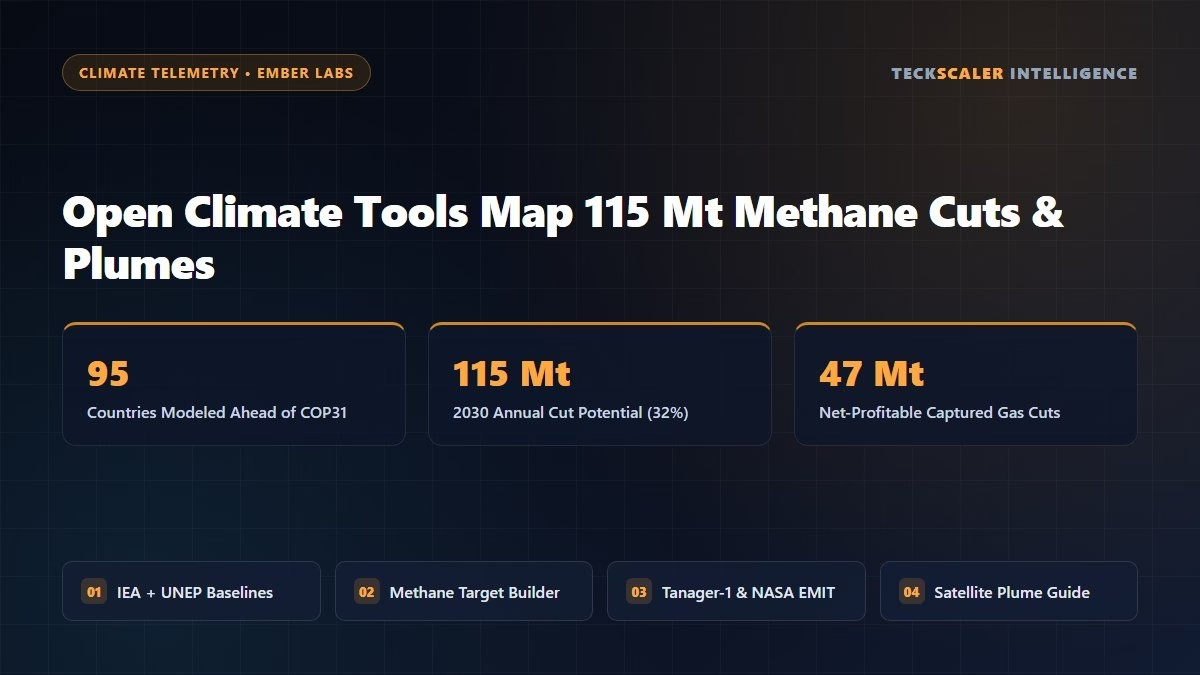

Energy group Ember launched two free web tools under Ember Labs. They help users weigh gas cuts and read space scans. Ember staff used AI to merge sheets and code web pages under human checks. Both run free with no login ahead of COP31.
The Methane Target Builder maps cut costs across 95 lands. It shows 115 million tonnes of yearly cuts by 2030, with 47 Mt paying for itself. Alongside it, the Coal Mine Methane Satellite Playbook teaches reporters to trace leaks using Carbon Mapper and NASA scans.
Executive Summary
- 95-Country Cost Tool: Methane Target Builder blends IEA 2026 and UNEP 2025 methane numbers across oil, coal, farms, and waste.
- 32% Global Cut Path: Existing steps could trim 115 Mt a year by 2030 (32% of 362 Mt human methane), with 47 Mt net-profitable.
- Public Plume Guide: Coal Mine Methane Satellite Playbook explains real detections from Carbon Mapper Tanager-1 and NASA JPL EMIT.
- Open AI Policy: Analysts Rebekah Horner and Adomas Liepa built the web apps with AI help, then checked unit math by hand.
- Labs Funnel: Ember Labs opened Nov. 6, 2026 to test early tools in public before promoting top winners into stable data feeds.
How the Methane Target Builder Prices Cross-Sector Cuts
Most methane tools focus strictly on oil and gas leaks. They skip farms and waste, even though those two drive over half of human methane (362 Mt a year). Data analyst Rebekah Horner blended IEA and UNEP tables so COP31 teams can test every sector at once.
Users pick any of 95 nations and set a 2030 goal. The tool sorts fixes from cheapest to highest cost per tonne until it meets the mark, then exports clean charts. Around 47 Mt of cuts pay for themselves since saved gas sells for more than gear costs.
“For many countries, there are numerous cuts that pay for themselves, because the captured gas is worth more than the equipment.”
Tracing Coal Mine Plumes Without a Space PhD
Space agencies post rich leak maps online, yet writers rarely know how to tie blurry gas plumes back to real coal pits. Scientist Adomas Liepa built the Playbook around real past leaks.
Guides pair Carbon Mapper Tanager-1 and NASA JPL EMIT scans with mine maps from Global Energy Monitor. Readers also see gaps between state claims and space data, matching sensor work in plant biosignal AI and green software audits.
How Ember Uses AI Without Hiding Errors
Research shops use coding bots to build web tools fast, yet quiet errors sneak into unit math easily. Ember’s public AI policy spells out where chatbots wrote UI code while staff checked all science math by hand.
Opened Nov. 6 beside grid and solar tools, Ember Labs tests nimble tools in public while big labs build dense simulators like MIT’s WorldParticle model.
Tool Matrix: Ember Labs Nov. 2026 Releases
Datasets, capabilities, and AI review notes for both public tools:
| Tool | Data Sources | Key Output |
|---|---|---|
| Methane Target Builder | IEA Tracker 2026; UNEP Report 2025 | Ranks abatement across 95 countries; 115 Mt potential cut |
| Satellite Playbook | Carbon Mapper Tanager-1; NASA EMIT; GEM | Teaches plume tracing & official vs. satellite checks |
| Access | Free on ember-labs.org (no login) | Early beta open for user feedback and funder backing |
| AI Audit Rule | Ember AI Use Policy | Human researchers verified unit math and research ties |
Frequently Asked Questions
What does Ember Labs’ Methane Target Builder show?
It lets anyone pick from 95 nations, set a 2030 cut goal, and rank cheap steps across gas, farms, and waste.
How much methane can current steps cut by 2030?
The tool shows current steps could cut 115 Mt a year (32% of human output), with 47 Mt paying for itself.
Which satellites power the Coal Mine Methane Satellite Playbook?
It uses public scans from Carbon Mapper’s Tanager-1 and NASA JPL’s EMIT plus Global Energy Monitor mine maps.
How did Ember build these tools with AI?
Staff used AI to merge files and code pages, then checked all math and methods by hand under Ember’s AI rules.