
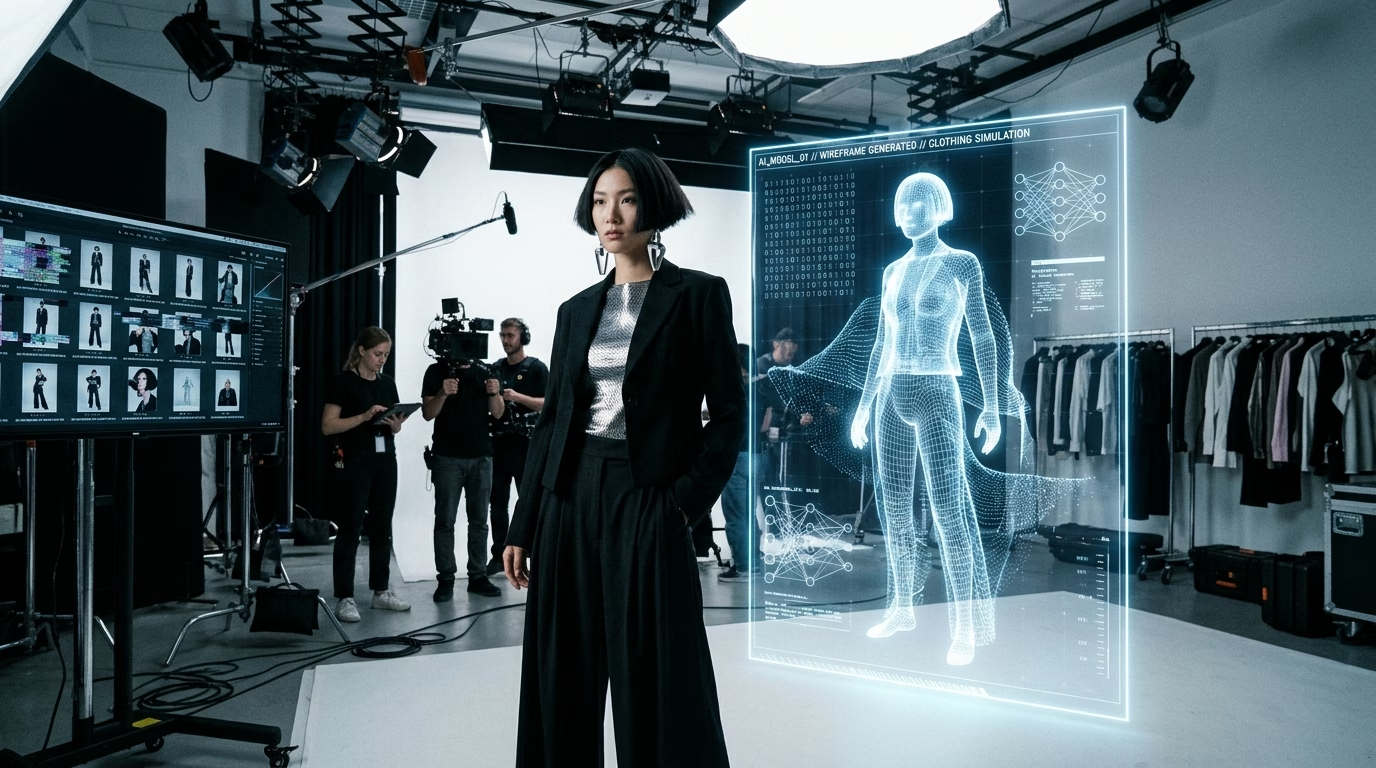

Can artificial intelligence software replace human fashion models on retail websites? Global brands love the massive cost savings, but the shift is threatening livelihoods across the fashion industry.
Generative AI lets online retailers make clean product images while cutting photo production budgets by 90 percent or more. For working models, the tech brings real danger. Scant rules exist to govern digital twins. Models now face unpaid likeness clones, or total replacement by synthetic bots.
Executive Key Takeaways
- Major Cost Cuts: Fast-fashion retailers are reducing catalog production costs by 90 percent or more by replacing human photo shoots with AI imagery.
- Secret Contract Terms: A Reuters report uncovered photo shoot contracts demanding rights to swap faces, create unpaid digital clones, and train AI models on human likenesses.
- Studio Closures and Layoffs: European fashion leader Zalando shut down two photo studios in Berlin and cut over 340 jobs, while its Scayle Studios unit produces 190,000 AI outfits monthly.
- Model Livelihoods at Risk: Working models warn that commercial e-commerce bookings, the financial foundation of the industry, could dry up within six months.
- Legal Protections Lag: The New York State Fashion Workers Act banned unauthorized digital replicas in June 2025, but most global markets lack binding laws.
The 90 Percent Cost Drop Reshaping Fashion Retail
An investigation by Reuters revealed the speed of the transition. Reporters spoke with 15 model agency directors. They also examined more than a dozen private photo shoot contracts from top brands, including Diesel, Calvin Klein, and L’Oreal.
The contracts showed bold legal demands. Brands asked for rights to swap model faces using AI. They sought to build digital clones with no extra pay. Some deals even asked to feed a model’s body into AI training tools.
The shift is already hitting the industry hard. Model agencies report falling bookings. Photo studios are closing down. Human models are losing e-commerce shoots, the steady work that pays their daily bills.
“Within six months, there will be fewer jobs for models, especially in e-commerce. If we do not speak up, the whole industry will just be bots in two years.”
Adot Gak, Fashion Model (Harper’s Bazaar, Balmain, H&M)
Production Factsheet: Traditional Photo Shoot vs. AI Model Pipeline
| Production Factor | Traditional Fashion Photo Shoot | Generative AI Model Pipeline |
|---|---|---|
| Cost Reduction | Standard Commercial Rates | 90% or Greater Budget Cut |
| Turnaround Time | Weeks of Booking and Post-Production | Minutes via Automated Software |
| Model Compensation | Daily Booking and Usage Fees | Zero Pay for Synthetic Avatars |
| Likeness Rights | Limited Campaign Usage Terms | Unpaid Digital Clones and Face Swaps |
| Physical Facilities | High-Cost Studio Spaces and Crews | Cloud Rendering Software Pipelines |
| Monthly Volume | Hundreds of Captured Outfits | 190,000+ Outfits (Scayle Studios) |
| Legal Protections | Negotiated Talent Agency Releases | Limited to New York State Workers Act |
| Human Labor Impact | Supports Models, Stylists, and Crew | Studio Closures and Broad Layoffs |
Secret Contract Terms: Face Swaps and Digital Twins
AI lets retailers reuse a single model image across many outfits without new photo shoots. Patrick Staal runs Uniko Models in Barcelona. “Some brands ask to modify faces, bodies, skin, or age after shoots using AI,” Staal said. “Others ask to build digital twins of models that they can reuse later without another shoot.”
The contracts reviewed by Reuters reveal how aggressive these demands have become:
- Diesel: In one deal, Diesel asked models to allow face and body changes. The terms allowed swapping faces among models. Diesel parent firm OTB said the contract was drafted for a specific project.
- Reale Actives: Skincare brand Reale Actives was founded by creator Alix Earle. A draft contract asked for rights to make AI replicas of models and use them for a year with no extra pay. Reale Actives said it uses human models and blamed the draft text on a partner firm.
- Calvin Klein: At Calvin Klein, a draft deal asked models to let the brand use their images to train AI tools without pay. Calvin Klein stated that it is testing new tools while respecting model rights.
- L’Oreal: L’Oreal asked for broad AI rights to adjust product looks and retouch images. L’Oreal noted that it uses standard editing tools that do not change model likenesses.
Melanie Howard is a partner at law firm Loeb & Loeb. She represents brands and creative talent. Howard warned that vague contract terms leave models exposed. “Such sweeping language is dangerous in its ambiguity,” Howard told Reuters.
Similar legal ambiguities over digital likeness rights have emerged across social media. Read our report on AI deepfakes targeting online creators for more.
Fast JSON to YAML Converter
Managing retail product catalogs, e-commerce feed schemas, or image pipeline metadata? Convert complex JSON and YAML configurations instantly in your browser with zero server tracking.
Studio Closures and Job Losses: The Zalando and Scayle Shift
Some online retailers are moving fast to replace human shoots. Zalando is Europe’s largest online fashion retailer. It rapidly added AI imagery and closed its two photo studios in Berlin, cutting over 340 jobs.
Its sister brand About You launched Scayle Studios. Scayle makes digital catalog images using AI models, promising cost cuts above 90 percent. Scayle already serves 130 brand clients. It generated 190,000 outfits in the last month alone.
“We are saving so much money. You’ve always had this super fast world of ecommerce, and this super slow traditional world of photo shoots, it didn’t fit together in any way. Now with AI, it’s a completely different scale.”
Julian Jansen, Vice President of Marketing, About You
Fast-fashion brands like Mango use AI models widely. But luxury brands move with care. Moncler tested an AI campaign in 2023 but does not use synthetic models today. Gucci drew mixed reviews when it posted AI images on Instagram.
Audience pushback is real. When film studios tried synthetic actors, China’s first AI movie flopped with just $18,000 at the box office. But in fast fashion, low costs often win out.
Scant Regulation and the New York Fashion Workers Act
Laws have struggled to keep up with synthetic media. The New York State Fashion Workers Act is a rare exception. The law passed in June 2025. It bans digital replicas of models without clear written consent.
Sara Ziff leads the Model Alliance, which backed the bill. “The misuse of model images is not new, but with AI that problem is accelerated tenfold,” Ziff told Reuters. She is pushing for federal protections.
In the UK, the British Fashion Model Agents Association published a voluntary AI code. It says brands must get consent before making digital twins. The model retains ownership of that twin. Yet voluntary codes carry no legal teeth.
“A lot of young talents don’t fully understand the long-term consequences yet. Signing away AI rights at 20 years old could still affect someone ten years later.”
Patrick Staal, Director, Uniko Models (Barcelona)
Frequently Asked Questions
How much money do brands save by using AI fashion models?
Retailers save 90 percent or more on production costs by using AI fashion models. Synthetic imagery eliminates expenses for physical studio rentals, hair and makeup crews, photographers, and recurring model booking fees.
What rights are fashion brands taking in photo shoot contracts?
Contracts show brands asking for face swaps and unpaid digital clones. Brands also want rights to train AI models on model likenesses without extra pay.
What is the New York Fashion Workers Act?
The New York Fashion Workers Act is a state law that took effect in June 2025. It prohibits brands and modeling agencies from creating, altering, or using digital replicas of models without explicit written consent.
Will AI-generated models replace human fashion models entirely?
AI models are rapidly taking over entry-level e-commerce catalog photography where speed and cost matter most. However, human models remain in demand for high-end luxury campaigns, runway shows, and brand storytelling where authentic prestige is required.
For more on the environmental costs and infrastructure trade-offs of generative software, read our analysis on whether EcoGPT and tree-planting AI chatbots actually reduce carbon emissions.






[…] For more on how automated software is reshaping corporate labor and legal rights, read our report on how AI fashion models cut retail costs by 90 percent and threaten human photo shoots. […]