
Kora Systems unveiled a Linux and Nix desktop OS on Nov. 10, 2026 built for coders and AI power users. Due for free release in 2027, Kora puts shared model context right inside the OS instead of splitting work across web tabs.
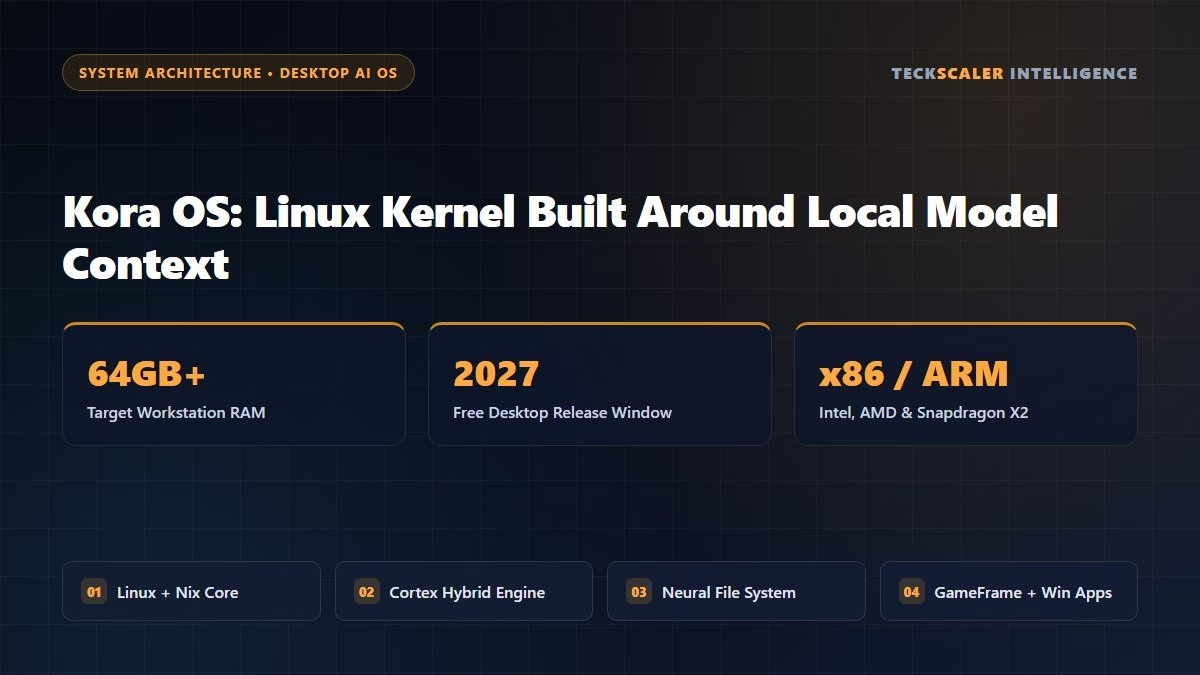
Started by ex-Cyanogen and Playtron CEO Kirt McMaster, Franck De Girolami, and ex-Google Android lead John Lagerling, Kora aims at rigs with 64GB+ RAM, per WIRED. Built-in wrappers also run Windows apps alongside a gaming mode named GameFrame.
Executive Summary
- Shared OS Memory: Kora’s Cortex Engine shifts tasks across CPU, GPU, NPU, OpenAI, and Anthropic while storing context on disk.
- Neural File Search: Sandboxed work zones index files by meaning so users find old contracts by memory, not filenames.
- 64GB RAM Focus: Targets desktops with 64GB+ RAM, doubling top memory specs on Google’s October-launched Googlebook laptops.
- x86 & Snapdragon: Supports Intel and AMD PCs plus Qualcomm Snapdragon X2 Elite chips, with a HUMAIN OS business tier.
- Games & Win Apps: Embeds Playtron’s GameOS layer as GameFrame alongside compatibility wrappers for Windows programs.
Inside Kora’s Cortex Engine and Neural File System
Power users waste minutes jumping between shells, editors, ChatGPT, and Claude, pasting files back and forth. Kora moves that memory layer straight down into the desktop OS.
Cofounder Franck De Girolami mapped the flow out clearly. Start a plan with OpenAI inside Kora, hand code steps cleanly to Anthropic tools, then route simple chores to local models to save token cash. Cortex splits work across CPU, GPU, NPU, remote servers, or peer home PCs.
Instead of deep nested folders, client sandboxes isolate each job while a neural file system indexes docs by topic. Typing a quick phrase into search pulls up buried deals without knowing folder names.
Targeting 64GB Rigs Against Windows and Googlebook
Google shipped its Gemini-centered Googlebook OS in October, yet McMaster called light web laptops too small for serious local weights. Tuning for 64GB+ PCs gives local models breathing room, matching cost trims we saw in self-hosted coding stacks.
“We can evolve much faster than macOS and Windows. When you’re a billion-user incumbent, it’s impossible to tip the boat.”
Pairing Linux and Nix with Qualcomm’s Snapdragon roadmap gives Kora fresh silicon reach. Still, desktop challengers face brutal odds, a hard truth McMaster saw years ago at Cyanogen.
What Power Users Should Check Before 2027
Building a full OS with under 100 staff leaves one huge test: app support. Kora ships core mail, calendar, and contact tools, plus an SDK and Windows wrappers for legacy apps.
Coders weighing local stacks against NVIDIA RTX desktops or Google-managed OS devices should watch 2027 betas to see how well Windows wrappers hold up.
System Specs: Kora OS Architecture & Targets
Confirmed core parts and hardware goals for Kora’s 2027 launch:
| OS Layer | Confirmed Design | User Benefit |
|---|---|---|
| Core Base | Linux & Nix desktop build | Clean package resets and direct hardware speed |
| AI Router | Cortex Engine (CPU/GPU/NPU + cloud) | Keeps shared context across local, OpenAI, and Anthropic |
| File Search | Neural file system + project sandboxes | Finds files by meaning without folder paths |
| Apps & Games | GameFrame + Windows wrappers | Plays PC games and standard Windows software |
| Chips & RAM | x86-64 + Snapdragon; 64GB+ target | Doubles memory headroom of top Googlebook laptops |
| Release Date | Free in 2027; HUMAIN OS business build | Built for AI coders rather than casual buyers |
Frequently Asked Questions
When does Kora OS launch and what does it cost?
Kora Systems plans a free desktop launch in 2027 along with a business HUMAIN OS deal.
Which chips and PCs run Kora OS?
Kora targets x86-64 Intel and AMD PCs plus Qualcomm Snapdragon laptops, tuned for rigs with 64GB+ RAM.
How does Kora OS differ from Windows or macOS?
Kora stores context locally via Cortex and a neural file system so users move smoothly across local, OpenAI, and Anthropic tools.
Can Kora OS run Windows programs and PC games?
Yes. Kora adds Windows app wrappers and folds Playtron’s GameFrame mode right into the dock.