

Table of Contents
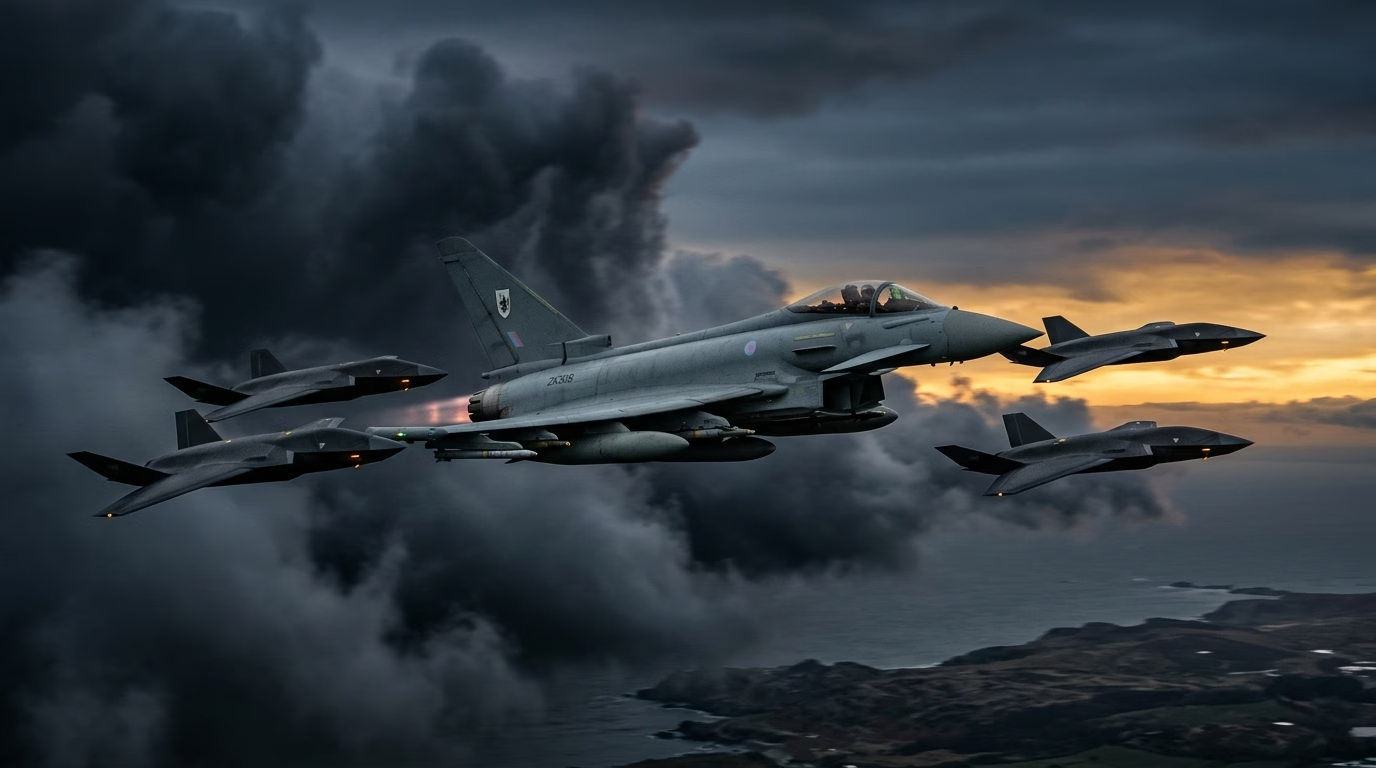
The Royal Air Force will build its future on autonomy, not flesh. Under the new plan, each Typhoon fighter jet will fly with four AI-powered drones. These drones can scout hundreds of miles ahead.
Air Chief Marshal Harv Smyth announced the shift in London. He said autonomous drones will change air combat. They will move human pilots to outer guardrail roles and ease pressure on pilot hiring. The plan readies the RAF for potential conflict by 2030, following a Nato readiness call.
“AI will enable warfare that speeds well beyond human comprehension,” Smyth said at the Royal United Services Institute. “Our role will shift towards the outside, and it will shift towards controlling the activity and setting the guardrails.”
- Loyal Wingman Integration: Each RAF Typhoon fighter will operate with four armed, autonomous escort drones under the £300m Storm Fighter project.
- Autonomy, Not Flesh: Doctrine shifts from human-crewed cockpits to algorithms managing frontline combat while human pilots set mission parameters.
- Target 2030 Deployment: Flight tests commence in 2027 to meet NATO directives to prepare for contested airspace against peer adversaries within 1,000 days.
- Force Multiplication: Drone escorts project radar jamming, sensor tracking, and guided weapons across contested sectors like the North Atlantic gap.
- Pilot Shortage Offset: Fully trained RAF personnel fell from 29,800 to 27,850 since 2020, making autonomous mass a demographic necessity.
Factsheet: Modern Military AI Systems in Contested Airspace
| Defense Program / System | Operating Military / Nation | Operational Function | Technical AI Mechanism |
|---|---|---|---|
| Storm Fighter (Loyal Wingman) | UK Royal Air Force (RAF) | Escort and strike for Typhoon jets | Autonomous formation, sensing, and EW |
| Maven Smart System | US Dept of Defense & Palantir | Automated targeting and battle planning | Computer vision, geospatial fusion |
| Collaborative Combat Aircraft (CCA) | US Air Force | Robotic escorts for F-35 and NGAD | Autonomous swarming and sensor netting |
| Terminal Visual Guidance Drones | Armed Forces of Ukraine & Russia | Deep precision strikes and EW bypass | Onboard optical recognition without GPS |
| Lavender & Habsora | Israel Defense Forces (IDF) | Accelerated target nomination | Algorithmic candidate scoring |
Project Storm and North Atlantic Standoff
The approach updates the second world war rule of steel over flesh. Commanders then used tanks and planes instead of mass infantry to stop bloody trench deaths. Smyth said modern warfare now demands an autonomy-first model.
The strategy centers on the £300m Storm Fighter project announced in July. The loyal wingman program pairs four armed drones with each crewed Typhoon. Flight tests start next year. The goal is full service by 2030. UK Defence Secretary Wes Streeting warned that the UK has roughly 1,000 days to prepare with allies.
The drones will act as force multipliers. They carry sensors, weapons, and radar jammers deep into contested skies. In one test plan, drones could track Russian planes through the Greenland-Iceland-UK gap. A single Typhoon pilot over Scotland could run the drone pack from hundreds of miles away.
Global Acceleration of Algorithmic Warfare
The plan mirrors a broader rise in military AI across global conflicts. The US military deployed the Maven Smart System, built with Palantir, to strike 1,000 targets in Iran in 24 hours. Israeli forces used database tools like Lavender and Habsora to speed up strikes.
In Ukraine, both sides now deploy drones with visual AI guidance. These drones track targets on the ground without radio or satellite links, ignoring local jamming. Autonomous Ukrainian drones also strike oil depots deep inside Russia.
This rapid defense automation parallels the broader industrial push toward autonomous hardware. In China, policymakers have prioritized embodied AI and robotics hardware to counter demographic shifts, while enacting strict state AI safety and algorithmic governance rules. In the West, multi-agent frameworks are migrating from clinical and enterprise testing directly into defense mission planning.
For the RAF, autonomy also solves a hiring pinch. Fully trained regular staff dropped from 29,800 in 2020 to 27,850 today. Autonomous drones let smaller air crews defend wide airspace with lower pilot risk.
Frequently Asked Questions
What is the RAF loyal wingman drone program?
It is a £300 million defense effort called Storm Fighter. It pairs four autonomous, armed drones with each crewed Typhoon fighter jet.
Why is the RAF moving toward an autonomy-first doctrine?
The RAF faces pilot hiring shortages and faster combat speeds. Autonomous drones add mass and scouting range while keeping human crews at safe standoff ranges.
How do autonomous drones bypass signal jamming?
Modern combat drones use onboard visual AI models. They spot ground shapes and vehicle outlines directly through cameras, flying without GPS or radio links.
What role will human pilots have in future drone swarms?
Human pilots will set mission rules and safety limits from standoff ranges. They command the drone pack while algorithms manage low-level flight and target tracking.
Configuring robotic autonomy stacks, ROS2 flight manifests, or UAV mission schemas? Convert and validate your payloads with TeckScaler’s free client-side JSON to YAML Converter.
🛡️ Engineering Autonomous Systems or Multi-Agent Edge Pipelines?
TeckScaler designs high-reliability edge computing architectures, real-time computer vision networks, and scalable distributed cloud backends. Consult with our systems engineers →
🔗 Related Defense & Autonomous Systems Analysis
- China Built the AI Safety System Silicon Valley Wants: Analysis of sovereign safety regulations for algorithmic and autonomous systems.
- China AI Stocks Drop $2.4T: STAR 50 Plunges 40%: How export curbs on humanoid and robotic systems impacted hardware manufacturers.
- Microsoft AI Outperforms Doctors in Diagnostic Study: How multi-agent coordinator networks solve problems monolithic prompts cannot.
Primary Sources: Royal Air Force | Royal United Services Institute (RUSI) | UK Ministry of Defence | The Guardian: RAF Autonomy Doctrine | Palantir Technologies: Defense Deployments






[…] militaries face similar autonomy choices, as the RAF announced plans to pair Typhoon fighters with four autonomous AI drones by 2030 under its new […]