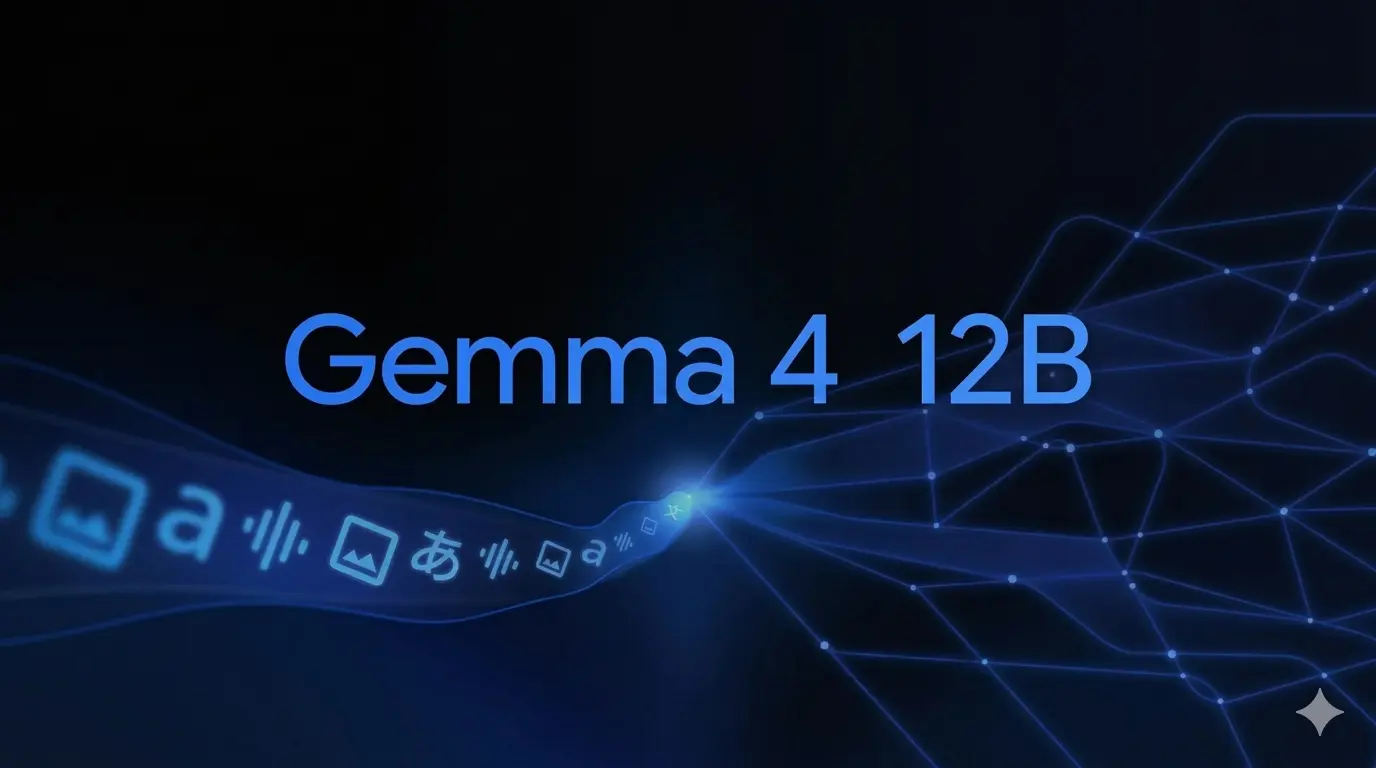

Google DeepMind just bridged a massive gap for the local AI movement. Their new Gemma 4 12B puts professional brain power directly onto standard laptops. This size class hits the “Goldilocks” zone for power and efficiency.
By sitting between the tiny E4B and the heavy 26B model, this release serves as a vital bridge. It offers a robust middle ground for everyday developers who need strength without the bulk. This balance makes high-end local work finally feel practical.
Memory efficiency remains the biggest hurdle for most AI users today. Since many professional laptops cap out at 16GB of RAM, Google targeted this specific threshold. This “magic number” allows the model to run without expensive upgrades.
- Optimized for standard consumer hardware.
- Requires only 16GB of VRAM or unified memory.
- Maintains high speeds without needing server-grade equipment.
Size class is only half the story behind this release. Traditional models often struggle with lag because they use separate encoders for every input type. To solve this, Google moved toward a unified, encoder-free architecture.
Instead of using separate translators, visual inputs are now processed through a single matrix multiplication. Raw audio signals project directly into the main backbone to minimize delay. This unified flow, coupled with Multi-Token Prediction (MTP) drafters, significantly slashes latency.
Being truly multimodal means the AI can see, hear, and speak natively. This lean design ensures that data flows faster through the system. It creates a more responsive experience for the user.
Native audio inputs allow the model to hear voice commands instantly. This immediacy transforms a simple chatbot into a real-time digital assistant.
The Apache 2.0 license ensures that developers can build these agents without restrictive proprietary hurdles. You can now create complex, multi-step workflows on your own machine.
The developer community has already downloaded the Gemma family 150 million times. This massive adoption proves the ecosystem is ready for professional-grade agentic tools.
Getting started is easy thanks to broad support across the major developer platforms. You can experiment with just a few clicks using the following tools:
- LM Studio and Ollama for local execution.
- Hugging Face and Kaggle for downloading model weights.
- Google AI Edge Gallery for specialized testing.
Developers should also explore the “Gemma Skills” repository to build more capable agents. While it shines on a laptop, the model also scales to Google Cloud. This flexibility makes it a turning point for AI enthusiasts everywhere.
Want to dive into the full technical details? Check out the original announcement on the Google Blog.