
Table of Contents
The $110 Billion Signal
The announcement on February 27, 2026, isn’t just another data point in the AI hype cycle; it’s the definitive “lab-to-scale transition” for the industry. By securing a $110 billion capital injection at a staggering $730 billion pre-money valuation, OpenAI has effectively declared the end of the experimental research era.
To put that in perspective, this valuation places OpenAI in the same weight class as legacy titans like Meta or Berkshire Hathaway, but with a fraction of the headcount and a much steeper growth trajectory. We aren’t looking at a software startup anymore; we’re looking at the emergence of a global infrastructure utility.
In my view, this moment reorders the entire hierarchy of the technology sector. For years, the market questioned whether LLMs were a sustainable business or just an expensive R&D project. This $110 billion signal, the largest private financing event I’ve ever tracked, answers that with a decisive “yes.” It suggests that the cost of entry for “Frontier AI” has reached a level that only a handful of nation-states and three or four corporations can afford. This valuation isn’t based on the promise of future intelligence, but on the reality of being the bedrock for the next century of economic activity. The window for any “scrappy” competitor to build a full-stack, global AI ecosystem is now officially slammed shut. This massive capital move is the prerequisite for the physical deployment of AGI, supported by a coalition of partners who control the world’s silicon, cloud, and capital markets.
Strategic Capital and Philanthropic Reach
OpenAI’s strengthened balance sheet is an offensive war chest, designed to solve the three existential constraints of the AI age: compute, distribution, and capital. This isn’t “dumb money” from passive funds; it’s a calculated alignment with the entities that own the stack. By bringing Amazon, NVIDIA, and SoftBank into the fold at this scale, OpenAI is essentially building a closed-loop ecosystem where they own the research, the hardware is guaranteed, and the distribution is pre-installed in the world’s largest cloud environments.
The current structure of the round, led by a $50 billion commitment from Amazon and $30 billion each from SoftBank and NVIDIA, creates a financial fortress. While more financial investors are expected to join (likely to provide the liquidity for secondary sales and employee retention), the strategic foundation is already set. This capital allows OpenAI to move with a “move fast and build things” mentality that would be impossible under the quarterly scrutiny of public markets.
OpenAI Capital Structure & Valuation (Feb 2026)
| Investor | Investment Amount | Strategic Role |
| Amazon | $50 Billion | Cloud infrastructure provider and enterprise distribution partner via Amazon Bedrock. |
| NVIDIA | $30 Billion | Primary hardware partner; provider of Vera Rubin, Blackwell, and Hopper systems. |
| SoftBank Group Corp | $30 Billion | Strategic long-term capital partner with massive global investment reach. |
| OpenAI Foundation | N/A (Stake Holder) | Philanthropic arm focusing on health breakthroughs and AI resilience. |
The “So What?” here extends far beyond the corporate balance sheet. The valuation of this round has a profound impact on the OpenAI Foundation, whose stake in the OpenAI Group is now worth over $180 billion. This instantly makes the Foundation one of the most well-resourced nonprofits in human history, surpassing even the largest sovereign-linked charities. With $180 billion in paper wealth, the Foundation’s capacity to fund “AI resilience” and health breakthroughs moves from theoretical to transformative. I suspect we’ll see the Foundation start acting like a shadow Ministry of Science, funding research into longevity and pandemic prevention that governments are too slow to touch. This financial decoupling allows the commercial arm to be aggressive while the nonprofit arm ensures the “AGI benefits all” mission isn’t just a marketing slogan. But even the most fortified balance sheet is a hallucination if people aren’t actually using the product, which brings us to the staggering velocity of OpenAI’s current adoption metrics.
The Metric-Driven Case for Frontier AI
The justification for a $730 billion valuation lies in the raw, undeniable data of user adoption. The “So What?” of the current metrics is clear: AI has moved from a novelty to a daily-use utility across every vertical. When a product achieves 900 million weekly active users (a number that suggests we are approaching total market saturation for the current internet-connected population), it stops being a “tool” and starts being an “environment.”
The adoption data for Codex and ChatGPT reveals a two-pronged attack on both the creative and corporate classes. Codex has seen its weekly user base more than triple since the start of 2026, reaching 1.6 million users. This means more people are now creating and shipping software that once required an entire engineering department. On the enterprise side, the numbers are even more aggressive. More than 9 million paying business users now rely on ChatGPT for work. We are seeing a pattern where teams start with individual productivity and move quickly to full-scale deployment across engineering, support, finance, and sales. These aren’t just users; they are “AI coworkers” being woven into the fabric of the modern workforce.
The “subscriber momentum” cited in the February 27 announcement is the most telling part of the story. Even with nearly a billion users, January and February 2026 are on track to be the largest months for new subscribers in the company’s history. OpenAI now boasts more than 50 million consumer subscribers (an astonishing conversion rate that most SaaS companies would kill for). This acceleration is driven by improvements users feel immediately: faster responses, higher reliability, stronger safety, and more consistent performance. I’ll be blunt: OpenAI is winning because the product is getting demonstrably better at a time when competitors are still struggling with hallucinations and latency. This surge in demand is the primary driver behind the massive physical infrastructure that OpenAI is now forced to build at an industrial scale.
A Deep-Dive into Industrial AI Scaling
To maintain this lead, OpenAI has identified three essential pillars required to meet the surging global demand: Compute, Distribution, and Capital. These aren’t just abstract concepts; they are the physical and financial constraints of the AGI race. As AI moves from the lab into the “daily use” phase, the bottleneck is no longer just “smarter models,” but the ability to serve those models to billions of people simultaneously without the system crashing or the latency becoming unbearable.
- Compute: This is the most immediate constraint. The requirement for next-generation hardware is no longer just about training the next big model; it’s about inference. To keep responses fast as usage hits the billion-user mark, OpenAI needs a massive, dedicated footprint of specialized silicon that can handle trillions of queries a day.
- Distribution: Having the best AI is irrelevant if users can’t access it where they already work. By aligning with partners like Amazon, OpenAI ensures its models are embedded directly into the cloud environments where startups, enterprises, and governments already live. This global reach allows them to bring frontier AI to communities that would otherwise be left behind.
- Capital: The $110 billion funding round provides the fuel for this transition. It allows OpenAI to move faster than the market by pre-funding the massive infrastructure projects, like the gigawatt-scale data centers, that take years to permit and build. Capital, in this context, is the bridge between a research mission and a global utility reality.
These pillars allow OpenAI to move faster on its mission to ensure AGI benefits humanity by providing the actual physical capacity to deliver those benefits. Without all three working in concert, the research stays trapped in the lab. This transition from conceptual goals to industrial execution is most visible in the complex web of silicon and cloud alliances that OpenAI has just cemented.
The Amazon and NVIDIA Synergy
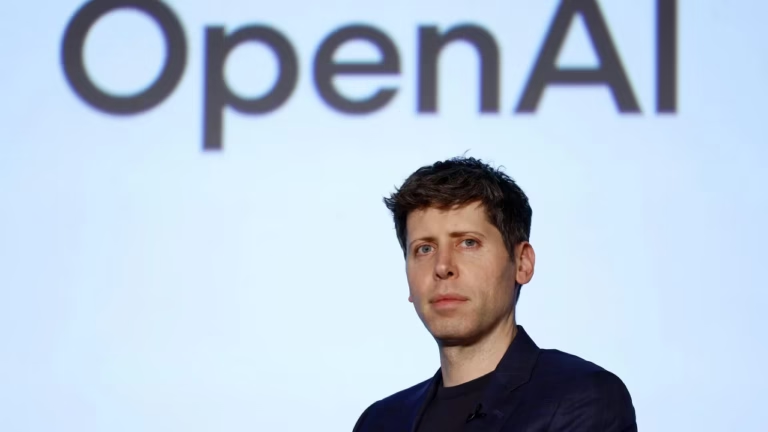
The true value of this funding round isn’t just the cash; it’s what Sam Altman calls “deep collaboration across the stack.” In the world of high-performance AI, hardware and software can’t be treated as separate entities. They must be co-designed. This is the “moat of physical reality” that OpenAI is building.
The collaboration with NVIDIA is the most technically significant. OpenAI is securing 3 GW of dedicated inference capacity and 2 GW of training on Vera Rubin systems. (To give you a sense of scale, 5 GW is roughly the power output of five nuclear reactors, this is a planetary-scale build-out). This expands upon the Hopper and Blackwell systems already in operation across Microsoft, OCI, and CoreWeave. By locking in the Vera Rubin architecture, OpenAI is essentially pre-ordering the future of AI hardware. NVIDIA becoming a lead investor in its own biggest customer creates a closed-loop ecosystem that competitors can’t touch. If you’re a rival lab, how do you compete when your supplier is literally your competitor’s largest shareholder?
The Amazon partnership is equally strategic, specifically the multi-year deal to accelerate AI for enterprises and startups. The introduction of the “Stateful Runtime Environment for Agents in Amazon Bedrock” is the “kill-shot” in the Agent race. For an AI to be an “agent,” it needs memory and the ability to perform tasks in a persistent environment. By integrating this into Bedrock, OpenAI and Amazon are providing the operating system for the next generation of automated workflows. It’s no longer about a chatbot that answers questions; it’s about a system that lives in the cloud and does your job for you.
If I’m being honest, these infrastructure partnerships are significantly more valuable than the $110 billion in cash. Cash can be raised by anyone with a decent slide deck, but 5 GW of dedicated capacity on the world’s most advanced silicon cannot be easily replicated. OpenAI is no longer just a research lab or a software company; it is the architect of a new global infrastructure, positioning itself as the indispensable platform for the next century. This trajectory toward global scale is now backed by the most formidable alliance in tech history, making their mission to define the AGI era seem less like an ambition and more like an inevitability.