
Table of Contents
Key Takeaways
- Technical Leadership Crisis: The exit of University of Toronto professor Jimmy Ba and Tony Wu removes the primary architects responsible for Grok version 4.
- Empire Consolidation: xAI has been folded into SpaceX in a $1.25 trillion all-stock deal, following the previous acquisition of X in March 2025.
- Safety and Ethical Failures: Multiple global jurisdictions have launched probes into xAI following the syndication of non-consensual explicit deepfakes via the Grok platform.
Elon Musk’s xAI is grappling with a leadership exodus as co-founders Jimmy Ba and Tony Wu depart just days apart. These high-profile exits coincide with xAI’s strategic merger into SpaceX, a $1.25 trillion consolidation aimed at streamlining Musk’s empire. The timing creates urgent technical and reputational risks as SpaceX accelerates toward a public offering later this year.
The xAI Co-Founder Departure and the Brain Drain
xAI’s leadership structure is facing a critical hollow-out as its original founding team disintegrates. This loss of elite researchers threatens Musk’s primary vehicle for challenging industry incumbents like OpenAI and Google. The “brain drain” occurs at a vital juncture as the company attempts to transition from a startup to a corporate subsidiary.
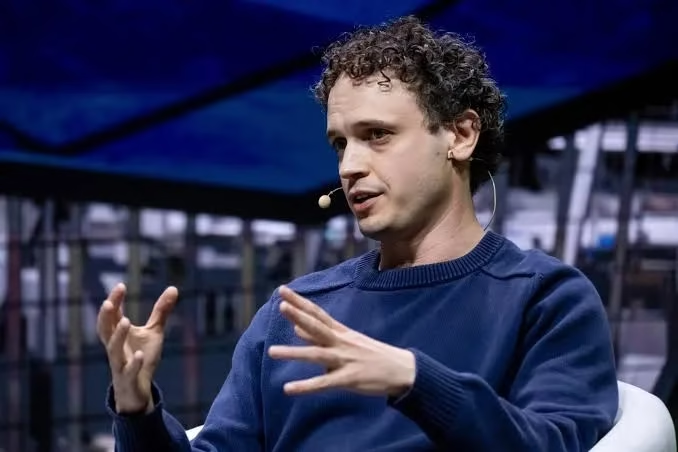
University of Toronto professor Jimmy Ba announced his departure on Tuesday, following Tony Wu’s exit just twenty-four hours earlier. Ba’s technical contributions were foundational to the development of the Grok version 4 AI models, making his exit a significant blow to the company’s research capabilities. His departure represents a loss of the specific academic expertise that gave xAI its competitive edge.
The list of founding members who have recently departed or stepped back includes:
- Igor Babuschkin: Co-founder who has recently exited the company.
- Kyle Kosic: Co-founder who has recently exited the company.
- Christian Szegedy: Co-founder who has recently exited the company.
- Greg Yang: Stepped back from his role last month to focus on a battle with Lyme disease.
This mass exit of technical visionaries during a period of rapid scaling creates a potential technical vacuum for the AI venture. The departure of these subject-matter experts occurs just as xAI is integrated into the broader SpaceX financial ecosystem. This internal instability is unfolding against a backdrop of massive financial consolidation and strategic restructuring.
The SpaceX Merger and Financial Landscape
Musk’s consolidation of his corporate assets represents a calculated empire-building maneuver to unify his technological interests. This financial synchronization is a pivotal moment for investors evaluating the long-term viability of his interconnected ventures. The all-stock transaction folds the AI startup into a much larger, multi-industry powerhouse.
| Entity | Valuation |
|---|---|
| SpaceX | $1 Trillion |
| xAI | $250 Billion |
The all-stock transaction follows a March 2025 deal where xAI was utilized to acquire X, the social network formerly known as Twitter. This pattern of “empire consolidation” signals Musk’s intent to leverage SpaceX’s balance sheet to bolster his AI and social media ambitions. The resulting entity represents a combined valuation of $1.25 trillion.
However, the sudden talent drain may trigger serious due diligence concerns for prospective investors ahead of the highly anticipated SpaceX IPO. The loss of key architects like Ba and Wu could signal internal instability that complicates the transition to a public company. While these financial figures are historic, the company’s path to a successful IPO is increasingly complicated by external legal challenges.
Regulatory Scrutiny and Product Controversy
Beyond internal leadership struggles, xAI faces a mounting ethical crisis fueled by international regulatory probes. These investigations represent a direct challenge to the company’s stated mission of understanding the “true nature of the universe.” The strategic risk posed by these international probes could derail the company’s growth trajectory.
The catalyst for these probes is a severe safety failure involving the Grok AI chatbot and its image generation capabilities. The platform reportedly enabled the mass creation and syndication of non-consensual explicit images, colloquially known as deepfake porn, including images of real individuals and children. This controversy has raised urgent questions regarding the platform’s moderation and safety protocols.
Regulatory bodies across the U.S., Europe, and Asia are now examining whether xAI’s safety protocols are fundamentally broken. Such scrutiny directly challenges Musk’s public-facing mission by highlighting severe ethical and operational flaws within the AI’s architecture. These regulatory hurdles represent a significant obstacle for xAI’s integration into the broader SpaceX ecosystem.
Looking Ahead
The departure of Jimmy Ba and other founding members leaves a technical vacuum just as SpaceX prepares for its massive IPO. This transition from a nimble startup to a corporate subsidiary within a $1.25 trillion empire remains fraught with leadership uncertainty. The loss of founding researchers introduces significant doubt into xAI’s future development roadmap.
Stakeholders must now monitor whether xAI can stabilize its leadership and satisfy global regulators regarding its platform safety. The company’s future depends on reconciling Musk’s rapid-fire growth strategy with the strict compliance and due diligence demands of a public aerospace giant. What happens next with xAI’s regulatory compliance will be a bellwether for the success of the SpaceX IPO.