
Table of Contents
The era of human-driven software is yielding to autonomous AI agents that can think and act independently. To reach their full potential, these agents need more than intelligence; they need the financial agency to buy their own resources.
Sapiom has secured $15 million to build the critical financial layer that allows AI to purchase its own services and compute power. This infrastructure is the key to turning AI from a conversational tool into an independent economic actor.
This breakthrough bridges the gap between simple AI prototypes and the practical world of production-ready software. It marks a transition from “vibe coding” experiments to a future where software manages its own needs.
From “Vibe Coding” Prototypes to Real-World Production
Vibe coding has revolutionized how non-technical creators build software using tools like Lovable and Bolt. By using plain-language descriptions to generate code, anyone can turn a rough idea into a working application almost instantly.
The friction begins when creators try to launch these apps into production by connecting them to external services. Managing manual API keys and credit cards for tools like Twilio or Stripe creates massive “infrastructure headaches” for non-coders.
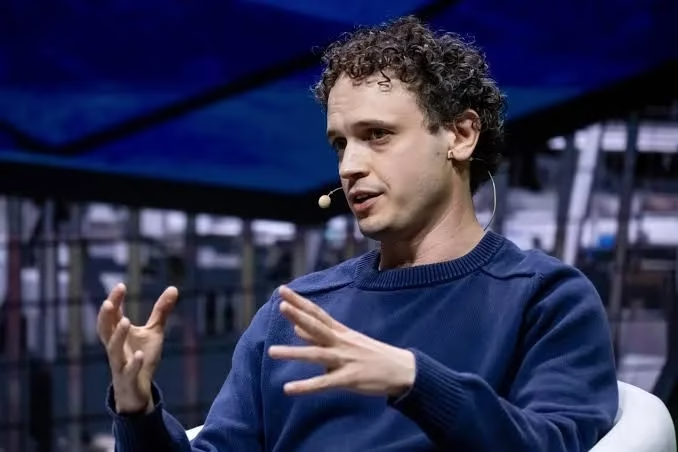
Ilan Zerbib, who served as Shopify’s director of engineering for payments, is building Sapiom to automate this friction away. He is on a mission to ensure that a lack of technical back-end knowledge doesn’t stop a great entrepreneurial idea from becoming a reality.
Sapiom: The Financial Layer for Autonomous Action
Next-generation enterprise AI requires a dedicated financial layer to handle a high volume of digital interactions. Sapiom functions as a specialized gateway that manages micro-payments for every individual server spin-up or data request.
The system allows AI agents to autonomously decide what to buy, such as compute power or SMS credits, without a human needing to enter payment details. Sapiom automates the friction away by replacing manual billing setups with a seamless pass-through fee model.
By treating every digital interaction as a financial event, Sapiom creates the “wallet” that autonomous agents have previously lacked. This infrastructure is the prerequisite for an economy where AI agents are active, spending participants.
Why VCs are Betting on Enterprise AI Infrastructure
Venture capitalists are prioritizing B2B infrastructure over consumer-facing apps in the current AI market. They are looking for the “plumbing” that will allow the entire automated economy to scale safely and efficiently.
Sapiom’s $15 million seed round reflects a unique convergence of AI and fintech powerhouses. The participating investors include:
- Accel (Lead)
- Anthropic
- Coinbase Ventures
- Okta Ventures
- Gradient Ventures
- Array Ventures
- Menlo Ventures
Amit Kumar, a partner at Accel, argues that every digital interaction is essentially a payment. He believes that focusing on enterprise financial infrastructure is the only way to make AI agents truly functional in the real world.
From Business Tasks to Personal Agents
The long-term vision for this technology moves beyond business APIs and into the world of personal financial assistants. Eventually, AI could handle many of the daily transactions that humans currently perform manually.
Personal AI agents may one day be trusted to handle consumer tasks like ordering an Uber or shopping on Amazon. This would require individuals to give their agents the authority to make independent financial decisions on their behalf.
Despite this exciting future, Zerbib is currently keeping his focus on B2B solutions. He believes the most immediate value lies in business infrastructure rather than simply finding ways to make people buy more things.
The Infrastructure for an Automated Economy
Sapiom is providing the essential foundation for a future where AI handles its own costs. This technology moves AI beyond simple conversation and allows it to handle the real-world expenses of its own operations.
By giving agents the power to pay, they are transforming from passive tools into active participants in the economy. It effectively provides the financial independence that autonomous agents have been missing.
This shift marks a turning point for the non-technical creators of tomorrow. It ensures that anyone with a good idea can build an app that is fully connected, funded, and ready to work.